Meghna Dekhtawala / August 25, 2026 / Pharmaceuticals
What Will Be Printed on a Pharmaceutical Carton in Kenya? What Manufacturers Need to Know
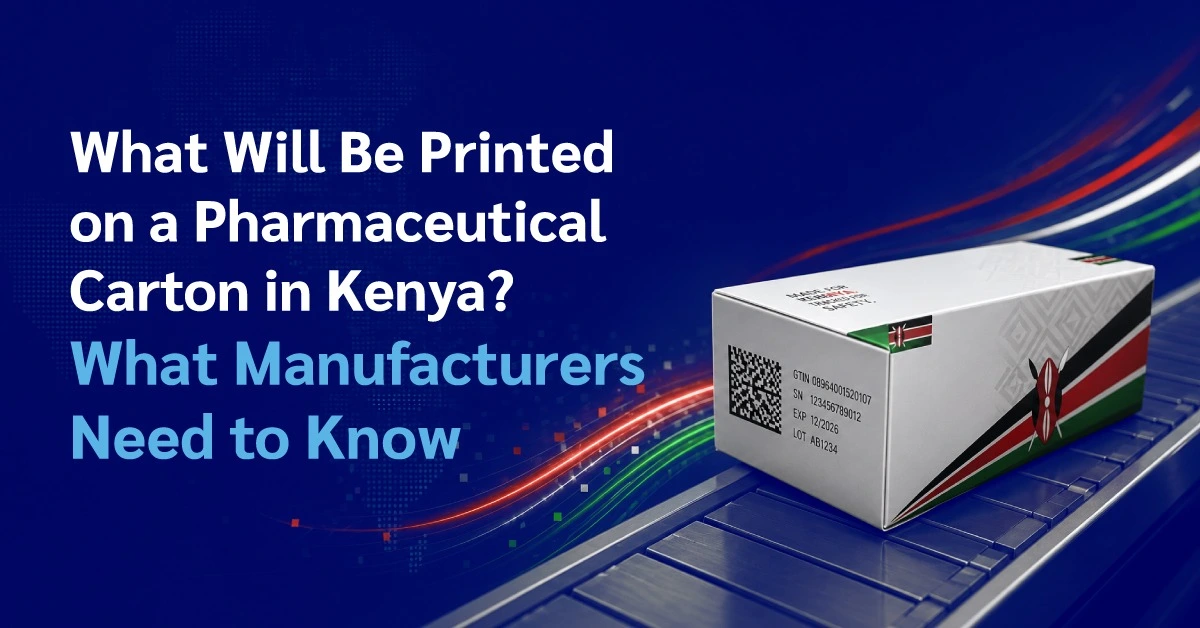
GTIN. Serial Number. Batch. Expiry. Four pieces of information can turn an ordinary pharmaceutical carton into a uniquely identifiable pack within a digital Track & Trace System.
For manufacturers preparing for Kenya pharmaceutical serialization requirements, knowing what could change on the carton is one of the most practical places to start. Which information belongs inside the 2D Data Matrix? What does the serial number actually do? And how does the packaging line make sure the information printed on every carton is correct and readable?
The answers go beyond artwork. A serialized carton connects the physical medicine pack to a digital identity. That connection has to remain accurate from serial-number generation and printing through inspection, rejection and data recording.
So before looking at the complete Track & Trace architecture, it helps to start with the object moving down the packaging line: the carton itself.
What Is Pharmaceutical Serialization?
Serialization gives an individual saleable pharmaceutical pack a unique identity. Unlike traditional identification, where a barcode may identify a product or a batch, serialization adds a unique serial number that distinguishes one individual pack from another.
For example, two cartons may have the same product identifier, batch and expiry date, but their serial numbers will be different.
That individual identity is the foundation for unit-level traceability and helps connect the physical product to the digital information recorded within a Track & Trace system.
What Goes Into the Pharmaceutical Data Matrix?
For healthcare applications, GS1 Kenya identifies GS1 Data Matrix as the preferred 2D barcode symbology for pharmaceutical and medical-device applications. GS1 Kenya states that a Data Matrix can encode information such as GTIN, batch or lot number, expiry date and a unique serial number, while occupying a compact footprint on the product.
For a serialized pharmaceutical carton, the key data can therefore be understood as:
GTIN → Serial Number → Batch/Lot → Expiry Date
Each element has a specific purpose.
GTIN: Which product is it?
The Global Trade Item Number (GTIN) identifies the product. It provides the product-level identity used within the GS1 system.
Serial Number: Which individual carton is it?
The serial number provides the unique identity of the individual saleable unit. This is the element that moves the pack from simple product identification toward unit-level serialization.
Batch or Lot Number: Which batch was it manufactured in?
The batch or lot number connects the individual carton to its manufacturing batch.
Expiry Date: When does the product expire?
The expiry date carries the product’s expiration information and can be encoded in the 2D barcode.
GS1’s specifications also define Application Identifiers for data such as batch/lot, expiration date and serial number.
However, there is an important distinction for manufacturers: GS1 standards describe what the technology can encode; the applicable Kenyan regulatory requirements determine what a manufacturer must implement for a particular product and phase. The latest Pharmacy and Poisons Board (PPB) guidance should therefore be checked before finalising artwork, coding specifications or a compliance project.
What Could a Serialized Pharmaceutical Carton Look Like?
A simplified example could look like this:
GS1 Data Matrix
[ 2D DATA MATRIX CODE ]
GTIN: 08912345678901
SERIAL: ABC123456789
BATCH: B240801
EXP: 08/2028
This is an illustrative example rather than a prescribed Kenyan carton artwork. The exact data structure, Application Identifiers, placement and human-readable requirements should be confirmed against the applicable regulatory and GS1 specifications.
The important point is that the Data Matrix is not merely another barcode. It is the machine-readable carrier connecting product identification and variable information to the traceability process.
Is Printing the Data Matrix Enough?
This is where many serialization projects become more complicated than they initially appear.
A manufacturer can have a printer capable of producing a Data Matrix and still have an incomplete serialization solution.
The packaging line needs to manage a connected sequence:
Generate → Print → Inspect → Verify → Reject → Record → Report
The serialization system must provide or manage the appropriate product and serialisation data. The correct information has to reach the printer. The code has to be printed consistently. The packaging line then needs to determine whether the printed code is present, readable and, where required, matches the expected data.
If the code is missing, damaged, unreadable or incorrect, the line needs a controlled way to identify and reject the affected pack.
That makes pharmaceutical serialization a Packaging-Line, Vision Inspection and data-management challenge, not simply a printing upgrade.
Why Data Matrix Verification Matters
At production speed, code quality can be affected by the carton substrate, ink, contrast, printer settings, vibration, positioning and other production conditions.
GS1 Kenya highlights high-speed capture of variable healthcare data as one of the requirements that GS1 Data Matrix addresses.
But a code being printed does not automatically mean it is reliably readable.
This is where Vision Inspection and code verification become important.
A vision system can check the presence and readability of the Data Matrix and, depending on the system architecture, verify the information encoded in it against the expected product data.
The principle is straightforward:
The serialization system creates the identity. The printer puts it on the carton. The vision system helps prove that the printed identity is correct.
Does Kenya Serialization Require a New Packaging Line?
Not necessarily.
For a manufacturer with an existing pharmaceutical Packaging Line, the first step should be a serialization readiness assessment, not an automatic decision to replace the line.
The assessment should consider:
- Can the existing printer produce a high-quality 2D Data Matrix at line speed?
- Is there sufficient space on the carton for the required code and human-readable information?
- Can the existing vision system verify the code?
- Can failed packs be automatically rejected?
- Can serialization software communicate with the line controls?
- Can the required production and serialization events be recorded?
- Can the system be validated and operated with appropriate access controls and audit trails?
Depending on the answers, a manufacturer may be able to upgrade selected parts of the line rather than replace the complete packaging system.
What About Aggregation?
Serialization and aggregation should not be treated as the same requirement.
Serialization identifies the individual carton. Aggregation establishes relationships between packaging levels.
For example:
Carton → Case → Pallet
An aggregation system can record which serialized cartons have been packed into a particular case and which cases belong to a particular pallet.
Whether aggregation is required for a particular Kenyan implementation should be determined from the applicable regulatory guidance. Manufacturers should avoid assuming that every Track & Trace market requires the same packaging hierarchy.
At the same time, an aggregation-ready architecture can be valuable for manufacturers supplying multiple export markets or planning for future regulatory requirements.
Why Kenya Pharmaceutical Serialization Requirements Matter
Kenya’s Track & Trace rollout is part of a broader regulatory and digital-health transformation. The Ministry of Health has described the system as a means of improving transparency, supply-chain visibility and patient safety, while the Pharmacy and Poisons Board has highlighted the use of track-and-trace technologies as part of stronger pharmaceutical regulatory oversight.
For manufacturers, that means the carton is becoming more than a physical package. It becomes a physical representation of a digital product identity.
The real question is therefore not simply:
“What do we print on the carton?”
It is:
“Can the packaging line prove that the carton carries the correct information — every time?”
How Should Manufacturers Prepare for Kenya Pharmaceutical Serialization?
Manufacturers preparing for the Kenya Pharmaceutical Serialization requirements can begin with a practical five-step assessment:
1. Review the existing packaging line
Map the current printing, inspection, rejection and data-capture process.
2. Identify serialization gaps
Check printers, cameras, controls, software, network connectivity and available space on the carton and line.
3. Define the data flow
Determine how product information and unique serial numbers will move from the serialization system to the packaging line and onward to the required reporting environment.
4. Test at actual production conditions
The solution should be evaluated using the real carton, printer, line speed and production environment rather than only a laboratory or demonstration setup.
5. Plan for what comes next
Kenya’s traceability environment will continue to evolve. A scalable architecture can help manufacturers add capabilities later without redesigning the complete packaging line.
Kenya Pharmaceutical Serialization Is More Than a Barcode
The Data Matrix may occupy only a small space on a pharmaceutical carton, but it represents a much larger digital process.
Behind that small symbol are product identification, serial-number management, printing, code verification, vision inspection, rejection, software integration and data management.
For pharmaceutical manufacturers, preparing for Kenya’s Track & Trace environment therefore means preparing the entire packaging process — not just installing a printer.
The manufacturers that assess their lines early will have more time to identify gaps, evaluate upgrade options, validate equipment and introduce serialization without unnecessary disruption to production.
Preparing for Kenya’s Track & Trace Requirements?
Jekson Vision provides pharmaceutical Track & Trace and serialization solutions designed to help manufacturers meet evolving regulatory requirements across pharmaceutical markets.
For Kenya, Jekson Vision has implemented solutions aligned with the country’s Track & Trace requirements, combining serialization, code printing and verification, vision inspection, line integration and Track & Trace software into a practical packaging-line solution.
Whether a manufacturer is upgrading an existing line or implementing serialization for the first time, Jekson Vision can assess the packaging environment and recommend the appropriate solution based on production requirements and regulatory needs.
Looking for a Track & Trace solution for Kenya? Call a Jekson Vision expert to discuss the requirements for your pharmaceutical packaging line and find the right serialization solution.
Frequently Asked Questions About Kenya Pharmaceutical Serialization
What are the Kenya pharmaceutical serialization requirements?
Kenya is implementing national pharmaceutical Track & Trace as part of its digital-health and regulatory reforms. Manufacturers should refer to the latest PPB implementation guidance for the requirements applicable to their products and implementation phase.
What information can a pharmaceutical Data Matrix contain?
GS1 Data Matrix can encode product identification and variable information such as GTIN, batch or lot number, expiry date and serial number. The exact information required for a Kenyan implementation should be confirmed against the applicable regulatory specifications.
Is a GS1 Data Matrix the same as a normal barcode?
No. A Data Matrix is a 2D barcode capable of carrying significantly more information in a compact area than many traditional linear barcodes. GS1 Kenya identifies GS1 Data Matrix as the preferred 2D symbology for pharmaceutical and medical-device applications.
Does pharmaceutical serialization require vision inspection?
The exact equipment configuration depends on the implementation, but vision inspection can help verify the presence, quality and readability of serialized codes and prevent incorrectly coded packs from continuing through the line.
Does Kenya require aggregation?
Serialization and aggregation are separate capabilities. Whether aggregation is required for a particular Kenyan implementation should be determined from the applicable regulatory requirements rather than assumed as part of every serialization project.

Meghna Dekhtawala