


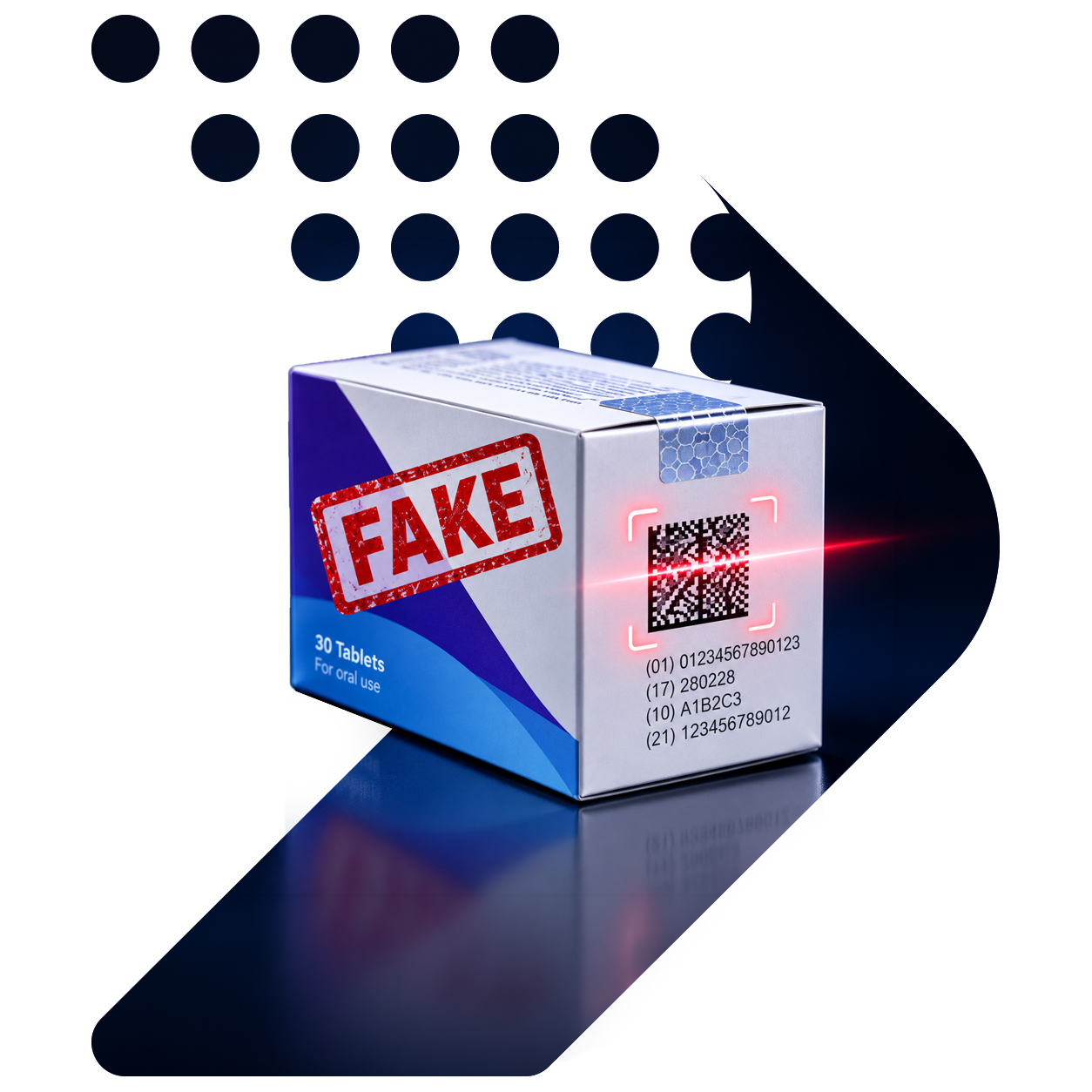
The EU Falsified Medicines Directive has been mandatory across Europe since 2019 — and Italy joined in 2025. Here is what your packaging line must do, what your software must handle, and how Jekson delivers it all from one partner.
The EU Falsified Medicines Directive — formally Directive 2011/62/EU, implemented through Commission Delegated Regulation (EU) 2016/161 — is the European Union's legal framework for preventing counterfeit and falsified medicines from entering the pharmaceutical supply chain. It became mandatory across EU member states on 9 February 2019.
EU FMD requires two physical safety features on every in-scope medicine pack. It also requires that every serialized pack is registered in a digital verification system before it enters distribution, and verified and decommissioned at the point of pharmacy dispensing.
The directive applies to all prescription medicines sold in the EU, plus a defined list of OTC medicines at risk of falsification. It covers Marketing Authorization Holders (MAHs), Contract Manufacturing Organizations (CMOs), parallel distributors, and repackagers — anyone who places or repackages an in-scope medicine for the EU market.
Every in-scope pack must carry a 2D DataMatrix code printed directly on the carton. The code must encode five data elements:
The DataMatrix must meet GS1 print quality Grade C or higher under ISO 15415. It must be readable by high-speed vision inspection cameras on the packaging line and by handheld pharmacy scanners at point of dispense. Failure to meet print quality grade results in verification failure and pack rejection.
Every in-scope pack must also carry a physical Anti-Tampering Device (ATD) — in practice a tamper-evident self-adhesive label applied across the carton closure. If the carton is opened, the ATD shows visible evidence of interference that cannot be concealed.
The ATD is a physical hardware requirement. It cannot be satisfied by printing alone — your packaging line needs a label applicator integrated with the serialization system. The applicator must confirm successful label placement before the pack passes downstream. Any pack where the ATD is not applied correctly must be rejected.
This is the requirement that makes Jekson's ST-series machines — the ST200, ST240 and ST250 — the central hardware for EU FMD compliance. They combine DataMatrix printing and inspection with tamper-evident label application and verification in a single integrated machine.
Printing the DataMatrix and applying the ATD is only the hardware side of EU FMD. The regulation also requires that every serial number is registered in a digital verification system — and verified and decommissioned when the pack is dispensed. This is handled through a two-level architecture.
The EMVS is the EU-wide hub operated by EMVO (European Medicines Verification Organisation), a not-for-profit entity established by pharma industry stakeholders. The EMVS does not connect directly to manufacturers or pharmacies. It connects the national systems.
Each EU member state operates its own National Medicines Verification System (NMVS). Manufacturers upload serial numbers to the NMVS for each country where their product will be sold. Pharmacies in that country query the NMVS when dispensing to confirm the pack is genuine and has not already been dispensed.
| Step | Who | What Happens |
|---|---|---|
| 1 | Manufacturer — line level | DataMatrix code printed on carton. ATD applied. Vision system verifies both. Pack passes or is rejected. |
| 2 | Manufacturer — L4/L5 software | Serial number commissioned — uploaded to the relevant national NMVS before batch is released from the manufacturing site. |
| 3 | Wholesaler / distributor | Pack moves through the supply chain. No verification required at wholesale level under EU FMD, but aggregation data supports logistics. |
| 4 | Pharmacy — point of dispense | Pharmacist scans the DataMatrix. Query goes to NMVS. NMVS confirms pack is genuine, active and not previously dispensed. |
| 5 | Pharmacy — decommissioning | NMVS decommissions the serial number. Pack cannot be dispensed again. Any duplicate or already-dispensed pack triggers an alert. |
Parallel traders who repackage or relabel medicines for a different EU market must decommission the original serial number, repackage, apply a new DataMatrix and ATD, and recommission the new serial number under their own MAH registration before the product can re-enter the supply chain. This is one of the most complex EU FMD scenarios and requires a fully capable L4/L5 system to manage correctly.
| Organisation Type | EU FMD Obligation |
|---|---|
| Marketing Authorization Holder (MAH) | Responsible for ensuring the pack carries compliant DataMatrix and ATD before release. Must upload serial numbers to the relevant NMVS. Responsible even if manufacturing is outsourced to a CMO. |
| Contract Manufacturing Organization (CMO) | Must apply the DataMatrix and ATD on the line on behalf of the MAH. Must coordinate serial number commissioning with the MAH's L4/L5 system. |
| Parallel Distributor / Repackager | Must decommission original serial numbers, repackage, apply new DataMatrix and ATD, and recommission under their own authorization before resale in a different EU market. |
| Importer (non-EU manufacturer) | Any manufacturer outside the EU exporting prescription medicines into the EU market must implement EU FMD-compliant serialization on their packaging lines for EU-destined product. |
| Wholesaler / Distributor | Must verify packs show no signs of tampering. Must report suspect packs. Not required to scan and verify serial numbers at wholesale level under current EU FMD — but many trading partners are requiring it contractually. |
EU FMD is a regulation across all 27 EU member states, plus EEA countries (Norway, Iceland, Liechtenstein) which adopted equivalent requirements. Three countries — Italy, Greece and Belgium — were granted a six-year exemption in 2019 due to pre-existing national label systems.
| Market | Status |
|---|---|
| EU-24 + EEA | MANDATORY since 9 February 2019. |
| Belgium | MANDATORY since 9 February 2019. Belgium implemented on the standard deadline despite having a prior vignette system. |
| Greece | MANDATORY from 7 February 2025. Hellenic Medicines Verification System (HMVS) became fully operational February 2025. |
| Italy | DUAL-COMPLIANCE PERIOD: 9 Feb 2025 – 8 Feb 2027. Both Bollini and EU FMD DataMatrix permitted simultaneously. FULL EU FMD ONLY from 9 February 2027. |
| United Kingdom | Outside EU FMD post-Brexit. Great Britain follows MHRA requirements. Northern Ireland follows Windsor Framework from January 2025 — 'UK Only' labelling applies, EU FMD disapplied. |
| Switzerland / Norway / Iceland | Adopted equivalent FMD requirements. Connected to EMVS. Treated as EU FMD markets in practice. |
Italy's pre-existing Bollino label system — tamper-evident state-issued stickers applied to every medicine pack since the 1990s — justified Italy's exemption until 2025. The Bollino carries the Italian national product code (AIC number) and functions as both a traceability label and a pharmacy reimbursement document.
From 9 February 2025, Italy entered a two-year stabilization period. Manufacturers supplying Italy must now run both systems in parallel on their lines — applying Bollini, printing and verifying EU FMD DataMatrix codes, applying ATDs, and uploading serial data to the Italian NMVS. From 9 February 2027, only EU FMD serialization is permitted and the Bollini system is discontinued entirely.
Jekson's ST240 and ST250 are specifically built to handle Bollini and Vignette label application and inspection alongside EU FMD DataMatrix serialization — the right machines for Italian market compliance during and after the transition.
For more detail on the Bollini transition, see our European Serialization hub page.
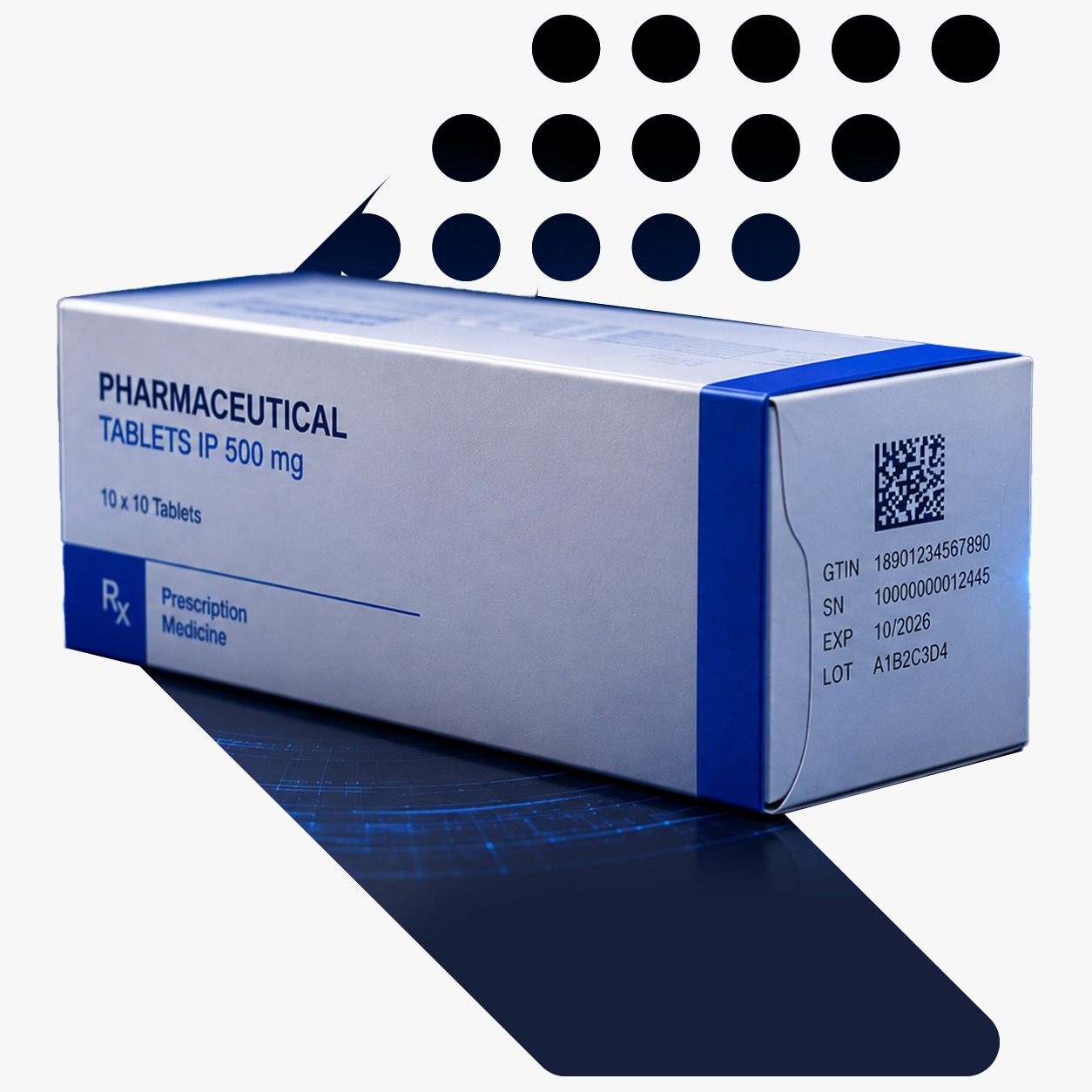
EU FMD compliance requires capability at every level of your operation — hardware on the line, software at site level, and an enterprise platform connecting to the NMVS. Here is the full picture:
| Level | Requirement | Jekson Solution |
|---|---|---|
| Line — Hardware | Print GS1 DataMatrix on carton. Apply tamper-evident ATD on both sides of carton closure. Inspect both. Reject non-conforming packs. Handle Bollini/Vignette labels if supplying Italy. |
ST200 (serialization + ATD) ST240 (serialization + ATD + Bollini/Vignette) ST250 (serialization + ATD + Bollini assembly) Jekson also provides independent Tamper evident system ST100 (if you have pre serialized cartons) |
| Line — Software (L1–L3) | Manage serial number lifecycle from generation to coding and verification. Recipe management for different markets and pack formats. Audit trail for GMP compliance. | REETRAK |
| Aggregation (recommended) | Build parent-child hierarchy linking packs to cases and pallets. Generate SSCC shipper labels. Push hierarchy data to enterprise system. | TS121 / TS200 / TS201 aggregation stations |
| Enterprise (L4/L5) | Commission serial numbers to national NMVS before batch release. Manage supply chain event reporting. Handle decommissioning and exceptions. ERP/MES integration. Multi-market NMVS management. | REESOURCE |
Based on our experience implementing serialization across European pharmaceutical packaging lines, these are the issues that most frequently cause compliance failures or production stoppages:
The ATD applicator misses a pack or applies the label incorrectly. If the vision system is not configured to verify ATD placement as a hard rejection criterion — not just the DataMatrix code — non-compliant packs pass through to market. EU FMD requires positive verification of both the UI and the ATD.
Manufacturers upload serial numbers to the NMVS after the batch has already left the site. EU FMD requires commissioning before the product is released for distribution. Late commissioning means the packs are technically uncertified at the point they enter the supply chain.
A manufacturer uploads serial numbers to the German NMVS for product destined for France. Each EU country has its own NMVS. Your L4/L5 system must upload to the correct national system for every market where the product will be sold. For manufacturers supplying multiple EU countries, this is a data management challenge that requires a capable multi-market enterprise platform.
Parallel traders who repackage medicines for a different EU market have the most complex EU FMD obligation of any supply chain participant. The decommission-repackage-recommission workflow must be fully supported by the L4/L5 system. Many companies discover this gap only when their first repackaged batch cannot be verified at pharmacy.
The DataMatrix code is printed at a quality level that passes the line's own camera but fails at pharmacy dispense scanners. EU FMD requires Grade C or higher under ISO 15415. Line cameras must be calibrated to this standard, not just set to read the code.
Manufacturers supplying Italy have until 9 February 2027 to transition fully to EU FMD — but from 9 February 2025 they must be capable of running both Bollini and DataMatrix serialization on the same line simultaneously. Lines that can only do one or the other are out of step with the stabilization period requirements.
Jekson provides the complete EU FMD solution stack — hardware, line software, enterprise software — all developed in-house and serviced by our own engineering teams in Europe.
Our ST200, ST240 and ST250 machines handle DataMatrix printing and inspection, ATD application and verification, and — for the Italian market — Bollini and Vignette label handling, all in a single integrated machine. They are CE Certified, 21 CFR Part 11 compliant, and powered by REETRAK.
→ See the full solution stack on our European Serialization Solutions page.
REETRAK manages serial number generation, DataMatrix encoding with all five EU FMD data elements including country-specific national product codes, label handling, vision inspection logic, and rejection management. It is developed in accordance with GAMP 5 guidelines and supports multi-market recipe management from a single software instance.
REESOURCE handles NMVS commissioning before batch release, supply chain event reporting, ERP and MES integration, EPCIS event generation, and exception management. For manufacturers supplying multiple EU markets, REESOURCE manages connections to multiple national NMVS systems from a single platform. It integrates with SAP, Oracle and other major ERP systems via REST, SOAP, SFTP and AS2.
Our 24×7 helpdesk covers remote diagnostics for both hardware and NMVS connectivity issues. Jekson's own engineering teams, based in Milan and Malta, are available across Europe for on-site installation, commissioning, validation support, and rapid hardware response.