Meghna Dekhtawala / August 27, 2026 / Packaging Line
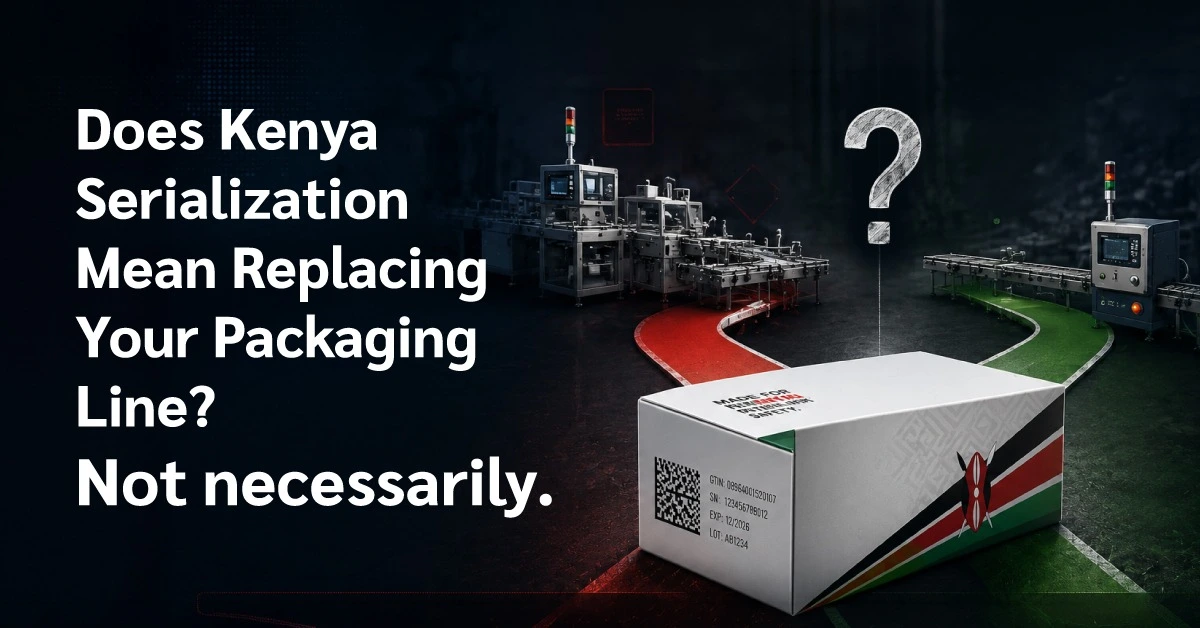
Does Kenya Serialization Mean Replacing Your Packaging Line? Not Necessarily.
A new serialization requirement does not automatically mean a new packaging line.
For pharmaceutical manufacturers exporting medicines to Kenya, that distinction matters. The country has moved into a new phase of digital pharmaceutical traceability, with Kenya’s National Track and Trace System becoming operational in July 2026. The Ministry of Health has positioned the system as part of a broader effort to improve supply-chain visibility, medicine safety and the fight against substandard and falsified medical products.
For an overseas pharmaceutical manufacturer supplying products to the Kenyan market, the immediate question is therefore not simply “Do we need serialization?”
It is:
“Can the existing packaging line be upgraded to support Kenya’s serialization and Track & Trace requirements?”
In many cases, the answer may be yes.
What Does Kenya Pharmaceutical Serialization Mean for Exporters?
Pharmaceutical Manufacturers outside Kenya that export medicines into the Kenyan market need to consider how their products will fit into Kenya’s evolving Track & Trace framework.
Kenya’s Ministry of Health has stated that its digital Track & Trace reforms use serialization and other technologies to improve medicine authenticity and traceability from production to the point of care.
That means the impact does not stop at the Kenyan border.
A manufacturer may be producing a medicine in India, Europe, Asia or another international market, but if that product is intended for the Kenyan pharmaceutical supply chain, the packaging and serialization process may need to support the applicable Kenyan requirements.
This makes Kenya Pharmaceutical Serialization a relevant consideration not only for local manufacturers, but also for international manufacturers and exporters supplying medicines to Kenya.
Does Kenya Serialization Require a New Packaging Line?
Not necessarily.
Serialization can often be introduced by integrating additional equipment and software into an existing packaging line.
The exact solution depends on the current line configuration, product format, production speed, existing coding equipment, available space and the required Track & Trace architecture.
An existing line may already have several of the components required for serialization.
For example, it may already have:
- A carton or label printer
- A vision inspection system
- A reject mechanism
- PLC-based line controls
- A barcode reader
- Product databases
- Line-level software
The challenge is determining which components can be retained, which need to be upgraded and which need to be added.
That is why a serialization readiness assessment should come before a major capital investment.
What Needs to Change on the Packaging Line?
A pharmaceutical serialization line typically needs to manage several connected functions:
Serialisation Data → Printing → Inspection → Verification → Rejection → Data Management
The individual steps may look simple, but they have to work together reliably.
1. Serialization data
The system needs to manage the unique identities assigned to individual saleable packs.
2. Code printing
The appropriate 2D Data Matrix needs to be printed on the carton or other applicable packaging component.
3. Code inspection
A vision system or code reader needs to determine whether the code is present and readable.
4. Data verification
The system may need to compare the information printed on the pack against the expected serialization data.
5. Automatic rejection
Incorrect, missing or unreadable codes need to be prevented from moving forward as compliant packs.
6. Data recording
The packaging event needs to be recorded within the applicable serialization and Track & Trace architecture.
This is why pharmaceutical serialization is not simply a printer installation.
Can the Existing Printer Be Used?
Sometimes.
The first question is whether the existing printer can produce the required 2D code at the required production speed and with sufficient print quality.
The assessment should consider:
- Printing technology
- Resolution
- Print speed
- Available printing area
- Carton material
- Ink and substrate compatibility
- Code placement
- Changeover requirements
- Production environment
If the existing printer is capable of meeting the required specifications, replacing it may not be necessary.
If it cannot, a new printer or coding technology may need to be integrated.
The same principle applies to the rest of the line: upgrade where practical rather than replace everything by default.
What About the Existing Vision Inspection System?
This is another area where manufacturers can potentially protect their existing investment.
A pharmaceutical packaging line may already use Vision Inspection to check:
- Product presence
- Carton integrity
- Printed text
- Barcode presence
- Leaflet presence
- Tamper evidence
- Correct artwork
However, serialization introduces another inspection requirement: the serialized code itself needs to be checked.
A serialization-ready vision system may need to determine whether the Data Matrix is:
- Present
- Correctly positioned
- Readable
- Printed with sufficient quality
- Associated with the expected product information
Depending on the system architecture, the vision system can also work with the serialization software to verify the data encoded in the code.
This is where an existing inspection system may need an upgrade rather than complete replacement.
What Happens When a Serialized Pack Fails Inspection?
This is one of the most important questions to address before modifying a line.
Suppose a carton receives a Data Matrix, but:
- The code is unreadable.
- The wrong batch information is printed.
- The serial number does not match the expected data.
- The code is missing.
- The print quality is insufficient for reliable scanning.
The packaging line needs a controlled way to identify and reject that pack.
A serialization project therefore needs to consider the entire reject mechanism, not just the camera.
The objective is simple:
A pack that cannot be reliably identified should not continue as a compliant serialized pack.
The reject process also needs to be properly integrated with the serialization data so that the system knows what happened to the affected serial number.
Does Serialization Affect Production Speed?
It can, if it is not engineered correctly.
This is particularly important for high-speed pharmaceutical packaging lines.
Adding a printer and camera without considering cycle time can create a bottleneck. The serialization system needs to operate within the line’s actual production conditions.
Manufacturers should therefore test:
- Maximum line speed
- Camera processing time
- Printer response
- Code-reading time
- Reject response time
- Communication between equipment
- Product spacing
- Changeover performance
A solution that works at a demonstration speed but cannot keep up with the actual packaging line is not a practical serialization solution.
How Does Track & Trace Software Support Pharmaceutical Serialization?
The packaging equipment is only one part of the solution.
Serialization creates data that needs to be managed.
Depending on the applicable implementation, the architecture can involve:
Level 1: Machine and packaging-line equipment
↓
Level 2: Line control
↓
Level 3: Site-level serialization management
↓
Level 4: Enterprise-level Track & Trace
↓
External systems / regulatory ecosystem
For exporters, this becomes particularly important because the pharmaceutical manufacturer may have an existing global serialization architecture.
The question then becomes:
Can the Kenya requirement be incorporated into the manufacturer’s existing serialization environment without creating a completely separate system?
A scalable Track & Trace architecture should ideally support multiple markets and regulatory requirements rather than forcing manufacturers to build a new system for every country.
What About Aggregation?
Serialization and aggregation should be evaluated separately.
Serialization identifies the individual saleable unit.
Aggregation establishes relationships between packaging levels.
For example:
Carton → Case → Pallet
An aggregation system can record which serialized cartons are packed into a particular case and which cases belong to a pallet.
Manufacturers exporting to multiple countries should therefore consider their broader market requirements when designing the packaging architecture.
If aggregation is not currently required for a particular Kenyan implementation, that does not necessarily mean an exporter should ignore it completely. A packaging line designed to accommodate future aggregation can be useful when the same production line supplies multiple regulated markets.
The applicable Kenyan regulatory requirements should always determine what is mandatory for products entering the Kenyan market.
How Should Pharmaceutical Exporters Prepare for Kenya Serialization?
The most effective approach is to begin with a Kenya serialization readiness assessment.
For an international pharmaceutical manufacturer, the assessment should cover the complete journey from the manufacturing site to the Kenyan market.
Step 1: Identify the Kenyan product portfolio
Determine which SKUs are being exported to Kenya and which packaging formats are involved.
Step 2: Review existing serialization capability
Identify what serialization equipment and software already exist at the manufacturing site.
Step 3: Assess the packaging line
Review printers, cameras, reject mechanisms, PLCs, line speeds and available installation space.
Step 4: Review the data architecture
Determine how the existing serialization system handles product data, serial numbers, packaging events and external reporting.
Step 5: Identify the gaps
Separate the requirements into:
Already compliant → Upgrade required → New equipment required → Software/integration required
Step 6: Validate the proposed solution
The upgraded system should be tested using the actual product, carton, printer, production speed and operating conditions.
This approach can prevent manufacturers from making unnecessary investments.
Why Replacing the Entire Line May Not Be the Best Answer
A complete line replacement can be expensive, disruptive and unnecessary.
For a manufacturer with a well-performing packaging line, a targeted serialization upgrade may provide a more practical route.
The existing equipment may already be performing critical functions effectively. Replacing everything simply because serialization is being introduced can mean discarding useful technology.
A better approach is to ask:
What does the existing line already do well?
Then:
What does Kenya’s serialization requirement add to that process?
And finally:
What is the most reliable way to integrate those additional capabilities?
This approach can protect existing capital investment while creating a packaging line capable of supporting the new requirements.
Serialization Should Be Designed for More Than One Market
This is particularly important for pharmaceutical exporters.
A manufacturer supplying Kenya may also supply other African, Middle Eastern, Asian, European or North American markets, each with its own serialization and Track & Trace requirements.
Designing a completely separate solution for every market can quickly become complicated.
A more strategic approach is to build a scalable serialization architecture that can accommodate different market requirements while maintaining a common core of equipment and data management.
That can make future regulatory changes easier to manage.
What Should a Manufacturer Look for in a Serialization Partner?
For an exporter preparing for Kenya pharmaceutical serialization, choosing the right technology partner is as important as choosing individual equipment.
The partner should be able to evaluate:
- Existing packaging equipment
- Serialization requirements
- Vision inspection
- Code verification
- Reject systems
- Line integration
- Serialization software
- Data management
- Validation requirements
- Future regulatory needs
Most importantly, the partner should be able to determine what needs to change — and what does not.
A good serialization project should not begin with:
“Here is the new machine.”
It should begin with:
“Here is what your existing line can already do, here is what Kenya requires, and here is the most efficient way to bridge the gap.”
Kenya Pharmaceutical Serialization Does Not Have to Mean Starting Again
For pharmaceutical exporters supplying the Kenyan market, serialization is an important packaging-line consideration.
But serialization does not automatically mean replacing the complete packaging line.
The right approach is to assess the existing equipment, identify the serialization gaps and integrate the required capabilities — from Data Matrix printing and vision verification to rejection, software and data management.
Kenya’s National Track and Trace System is now part of the country’s pharmaceutical digital infrastructure, and the regulatory environment will continue to evolve. Manufacturers exporting medicines into Kenya should therefore look at serialization not as a one-time equipment purchase, but as part of a scalable Track & Trace strategy.
The goal is not to replace a packaging line simply because serialization is coming.
The goal is to make the existing packaging line serialization-ready — reliably, efficiently and with room for what comes next.
Preparing for Kenya’s Track & Trace Requirements?
Jekson Vision provides pharmaceutical serialization and Track & Trace solutions for manufacturers supplying regulated markets worldwide.
For pharmaceutical manufacturers and exporters supplying medicines to Kenya, Jekson Vision can support the transition with serialization, 2D Data Matrix printing and verification, vision inspection, automatic rejection, line integration and Track & Trace software.
Jekson Vision has implemented solutions aligned with Kenya’s Track & Trace requirements, helping pharmaceutical manufacturers connect regulatory requirements with practical packaging-line execution.
Whether an existing line needs a targeted upgrade or a new serialization solution is required, Jekson Vision can assess the current packaging environment and identify the most appropriate path forward.
Exporting medicines to Kenya? Speak to a Jekson Vision Track & Trace expert to assess your existing packaging line and find the right serialization solution for the Kenyan market.
Frequently Asked Questions About Kenya Pharmaceutical Serialization
Does Kenya pharmaceutical serialization apply to exporters?
Pharmaceutical manufacturers outside Kenya that supply medicines into the Kenyan market should assess the applicable Kenyan Track & Trace and serialization requirements for their products. The requirements and implementation obligations should be confirmed with the relevant Kenyan regulatory guidance and supply-chain partners.
Does pharmaceutical serialization require a new packaging line?
No. An existing packaging line may be upgraded with serialization printers, vision inspection, code verification, rejection and software integration, depending on its existing configuration and the applicable requirements.
Can an existing pharmaceutical printer be used for serialization?
Potentially. The existing printer should be assessed for its ability to produce the required 2D code at the required speed, resolution and print quality.
Can an existing vision inspection system be upgraded?
In some cases, yes. The existing vision system should be assessed for its ability to inspect and verify the required Data Matrix and integrate with the serialization architecture.
Does Kenya require aggregation?
Serialization and aggregation are separate capabilities. Whether aggregation is required for a particular Kenyan implementation should be determined from the applicable regulatory requirements.
What should a pharmaceutical exporter do first?
The first step should be a serialization readiness assessment covering the existing packaging line, printing, vision inspection, rejection, software, data flow and integration requirements.
Why should exporters plan serialization early?
Early planning gives manufacturers time to assess existing equipment, compare upgrade and replacement options, validate the solution and integrate Kenya requirements into their wider global Track & Trace strategy without unnecessary disruption to production.

Meghna Dekhtawala
Senior Marketing Manage
RECENT POSTS