Ritesh Indulkar / June 12, 2026 / Pharmaceuticals
How Pharma Manufacturers Can Meet Taiwan TFDA Track & Trace Rules
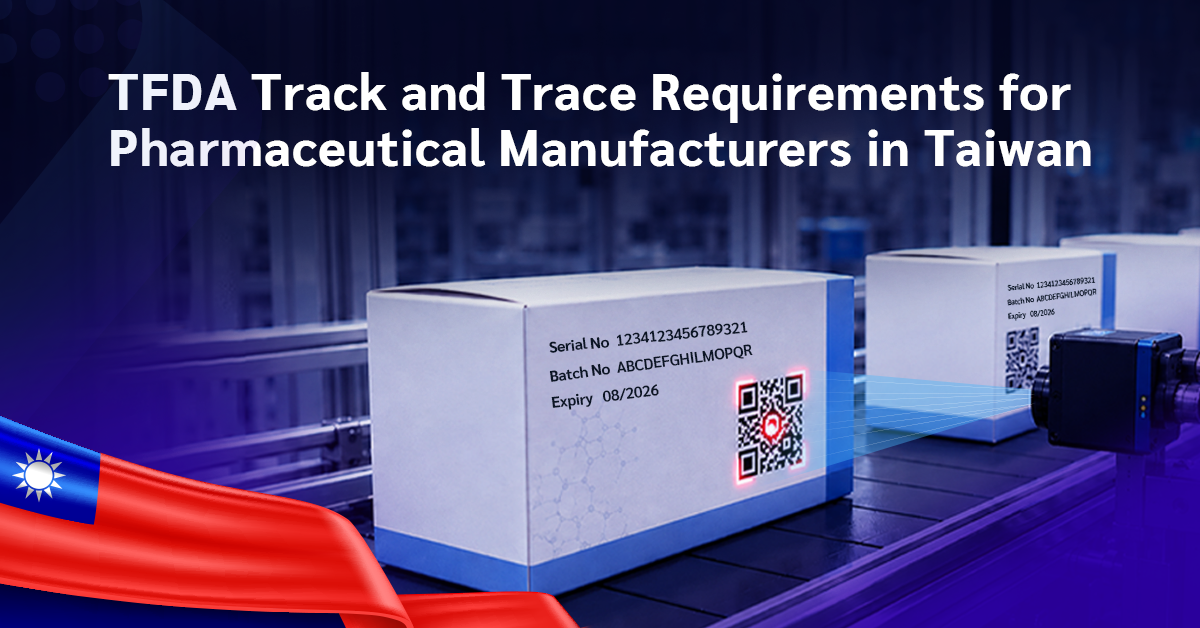
If your pharmaceutical packaging line operates in Taiwan, track and trace is not optional — it is mandated under the Pharmaceutical Affairs Act and actively enforced by Taiwan’s Food and Drug Administration (TFDA). Yet in our conversations with manufacturers across Asia, the same gap appears repeatedly: serialisation software is in place, but the physical verification of the printed data on the line is not.
What Are Taiwan TFDA Track and Trace Requirements?
Taiwan has established one of Asia’s most structured pharmaceutical traceability frameworks. The TFDA mandates a full Track And Trace System that monitors pharmaceutical products from manufacturing through to patient delivery — every stage, every stakeholder, every batch.
The key requirements manufacturers must meet:
- Lot-level traceability as a baseline for all pharmaceutical products
- Unit-level serialisation for higher-risk medications, increasingly enforced
- GS1-128 barcoding standards for product identification on packaging
- Comprehensive documentation submitted to the TFDA by manufacturers, distributors, and retailers
- Centralised data management through TFDA-approved reporting platforms
- Batch records, transaction records, and movement data maintained as a continuous audit trail
Key regulation
The Pharmaceutical Affairs Act requires all pharmaceutical entities operating in Taiwan to maintain detailed records at every stage of the supply chain — including production, distribution, and point-of-sale data. Non-compliance creates both regulatory exposure and product liability risk.
Where Most Pharma Lines Fall Short
The TFDA’s requirements are clear. The gap is in execution — specifically, at the point of print.
Most manufacturers invest in serialisation software, ERP integration, and reporting platforms. What they underestimate is the importance of verifying the physical output: the lot number, expiry date, and 2D barcode as they appear on the blister, carton, or bottle — before it is sealed and shipped.
An unreadable code that passes the line without verification is a compliance failure regardless of how robust your software stack is. Common failure points include:
- 2D barcodes printed correctly but failing TFDA scan thresholds due to low substrate contrast
- Lot and expiry data readable to the human eye but below machine-readable grade standards
- Date codes that pass visual inspection but contain transpositions caught only at the point of sale or during a recall
- Missing or partially printed batch codes on high-speed blister lines running without 100% inline verification
What 100% Inline Variable Data Inspection Provides
Inline variable data inspection — running at full line speed, on every unit, not on a sample — closes the gap between your serialisation system and your physical output.
A correctly implemented system verifies:
- That the lot number and expiry date match the batch record in your ERP or MES
- That the 2D barcode grades above the minimum readable threshold
- That no character is missing, transposed, or illegible
- That every unit that passes the line has a timestamped digital inspection record
This last point — the tamper-proof digital inspection log — is increasingly what TFDA auditors look for during inspections. A clean inspection trail demonstrates process control, not just system installation.
Jekson Vision’s Approach to TFDA Compliance
Jekson Vision’s AI-powered variable data inspection systems are designed for pharmaceutical packaging lines operating under regulated market requirements. The platform verifies every printed code inline, cross-references it against the batch record, and generates a digital inspection log per unit — all at full line speed.
Our systems integrate with our existing serialisation stacks and packaging line PLCs. There is no need to replace your serialisation software — we operate at the physical output layer, verifying that what the line prints matches what the system records.
Preparing for a TFDA Inspection
Before your next TFDA inspection, these are the questions worth putting to your line team:
- Can we produce a complete digital audit trail for every unit produced on this line in the last 90 days?
- Are our batch records cross-referenced to physical inspection logs — or are we relying on operator spot-checks?
- Can we demonstrate that every 2D code printed on this line graded above the minimum scan threshold?
- If a defect escaped the line, can we identify the exact units affected and the timeframe?
If any of those answers involve paper logs, sampling, or manual verification, there is a documentation risk worth addressing before an audit surfaces it.
Want to know if your current inspection process meets TFDA documentation standards?
Jekson Vision offers a complimentary 30-minute remote inspection gap assessment for pharma manufacturers in Taiwan. No sales pitch — just a plain-language review of where your current process has gaps. Contact us at www.jeksonvision.com
Frequently Asked Questions
- Is unit-level serialisation mandatory in Taiwan?
Lot-level traceability is the current baseline requirement under the TFDA framework. Unit-level serialisation is increasingly required for higher-risk medications and is expected to expand. Manufacturers exporting to regulated markets (EU, US) are already subject to unit-level requirements under those jurisdictions. - What barcode standard does TFDA require?
The TFDA recognises GS1-128 as the primary standard for pharmaceutical product identification. Many higher-risk products also use GS1 DataMatrix for unit-level serialisation. - What inspection records are required for a TFDA audit?
Manufacturers should be able to demonstrate a complete batch record including manufacturing data, packaging line data, print verification records, and distribution records. Digital, timestamped inspection logs are increasingly preferred over manual records
Note:
The regulatory information in this article is based on publicly available TFDA guidance and industry sources current as of May 2026. Taiwan’s pharmaceutical regulatory framework is subject to ongoing revision… Readers are strongly advised to verify current requirements directly with the Taiwan Food and Drug Administration (tfda.mohw.gov.tw) or consult a qualified Taiwan regulatory affairs professional before making compliance decisions. This article does not constitute regulatory or legal advice.

Ritesh Indulkar