Ritesh Indulkar / August 24, 2026 / Pharmaceuticals
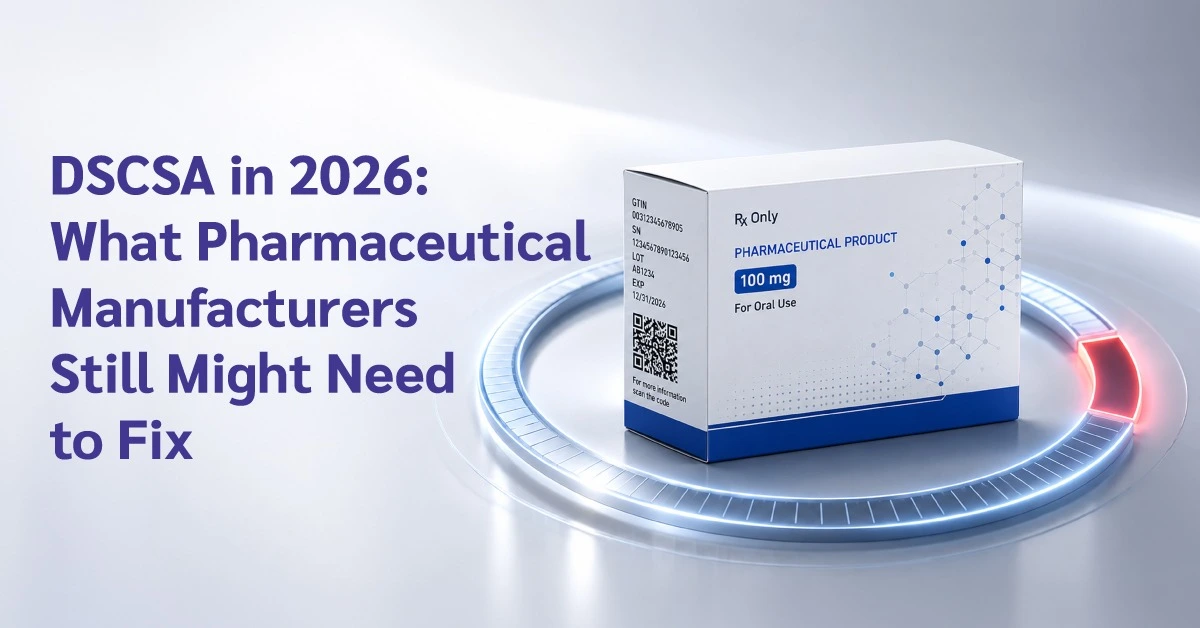
DSCSA in 2026: What Pharmaceutical Manufacturers Still Might Need to Fix
The Drug Supply Chain Security Act has moved well beyond the “implementation” phase. For Pharmaceutical Manufacturers, the bigger question in 2026 is no longer whether serialization is in place — it is whether the entire system actually works when the data, packaging line, trading partners and exceptions are put to the test.
The U.S. pharmaceutical supply chain has spent years preparing for the Drug Supply Chain Security Act (DSCSA). Manufacturers have installed serialization systems, upgraded packaging lines, implemented aggregation, connected with trading partners and invested in electronic data exchange.
But there is an important distinction between having a DSCSA system and having a DSCSA operation that works reliably at scale.
That distinction matters in 2026.
The FDA’s enhanced drug distribution security requirements are designed around interoperable, electronic tracing of products at the package level. FDA guidance recommends the use of GS1 Electronic Product Code Information Services (EPCIS) standards to support secure, interoperable data exchange across the pharmaceutical distribution chain.
For manufacturers, the focus now needs to shift from implementation to operational maturity.
10 Key DSCSA Areas Pharmaceutical Manufacturers Should Review in 2026
1. Serialization Is Not the Same as Traceability
This is probably the most important distinction.
A Packaging Line can successfully print a unique serial number on every saleable unit and still have significant traceability gaps.
Serialization answers:
“What unique identity did we assign to this package?”
Traceability goes much further:
“Can we reliably understand what happened to that package throughout the supply chain?”
That requires the physical product and its digital identity to remain connected as the product moves through different levels of packaging and distribution.
For a manufacturer, this means looking beyond the serialization printer or camera.
You need to consider the complete flow:
Product → Serialization → Inspection → Aggregation → Reconciliation → L3 → L4 → EPCIS → Trading Partner
If one part of that chain is unreliable, the overall traceability process can become unreliable.
2. EPCIS Should Not Be Treated as an IT-Only Project
One of the biggest mistakes manufacturers can make is treating EPCIS as something that happens after the packaging line.
It doesn’t.
The quality of the data exchanged through EPCIS is heavily influenced by what happens on the production floor.
Think about a simple example.
If a package is serialized incorrectly, if an aggregation relationship is wrong, or if a parent-child relationship is not properly recorded, the problem doesn’t magically disappear when the data reaches an enterprise system.
The problem has simply moved downstream.
FDA recommends EPCIS as a standard for interoperable electronic exchange of DSCSA transaction information.
That means manufacturers should be asking:
- Are we generating the right events?
- Is the data complete?
- Is our master data accurate?
- Are parent-child relationships reliable?
- Are aggregation events being captured correctly?
- Can our system handle exceptions?
- Can we reconcile physical products with digital records?
- Can we exchange information reliably with every relevant trading partner?
EPCIS is ultimately a data-quality problem as much as it is an IT problem.
3. Aggregation Remains One of the Weakest Links
Serialization gets most of the attention because the serial number is visible on the package.
Aggregation is different.
A serialized carton may be correctly identified, but the system also needs to know which cartons belong to which bundle, case or pallet.
For example:
10 cartons → 1 case → 1 pallet
That relationship creates a digital hierarchy.
If the physical hierarchy and the digital hierarchy don’t match, downstream operations can be affected.
Common causes include:
- Missed scans
- Damaged or poorly printed codes
- Incorrect parent-child relationships
- Manual interventions
- Rework
- Product removed from a case without proper disaggregation
- Incorrect reconciliation
- Camera or scanner failures
- Operator errors
- Software integration problems
Manufacturers should therefore measure more than serialization uptime.
They should also measure:
Aggregation accuracy.
Reconciliation failures.
Manual interventions.
Rework.
Exception frequency.
These metrics tell you much more about the health of your traceability operation.
4. “The barcode scans” is not necessarily good enough
This is another area where manufacturers should take a closer look.
A Barcode that can be decoded is not automatically a barcode that meets every quality requirement.
There is a difference between:
Reading a code
and
Verifying the quality and correctness of a code.
On a pharmaceutical packaging line, manufacturers may need to check elements such as:
- GTIN
- Serial number
- Lot or batch number
- Expiration date
- Data structure
- Print quality
- Position
- Contrast
- Quiet zone
- OCR/OCV information
- Barcode readability
A Vision Inspection System can play an important role here.
The objective isn’t simply to ask:
“Can the camera read the code?”
It should also ask:
“Is this the correct code, in the correct format, printed correctly, on the correct product?”
That distinction can become particularly important when production volumes are high and the cost of downstream errors is significant.
5. Exception handling needs as much attention as normal production
Most systems look good when everything goes according to plan.
The real test comes when something goes wrong.
What happens when:
- A serial number cannot be read?
- A carton is rejected?
- A case is opened?
- A product is removed from an aggregation hierarchy?
- A duplicate serial number appears?
- An aggregation relationship is incorrect?
- A network connection goes down?
- An EPCIS message fails?
- A trading partner cannot accept the transaction?
- A product needs to be investigated?
These are not edge cases in a complex pharmaceutical supply chain.
They are operational realities.
FDA’s DSCSA framework includes requirements and guidance around verification, including processes for suspect and illegitimate products.
Manufacturers should therefore test their exception workflows just as seriously as their normal production workflows.
A good DSCSA system isn’t one that never encounters exceptions.
It is one that can identify, isolate, investigate, resolve and document them efficiently.
6. Don’t let the stabilization period become a reason to delay improvements
The FDA introduced compliance policies and exemptions to provide additional time for trading partners to build and stabilize interoperable systems and processes.
There are also specific exemptions for certain small dispensers extending through November 27, 2026.
For manufacturers, however, this shouldn’t be interpreted as:
“We have more time, so we can wait.”
The better interpretation is:
“We have an opportunity to fix what isn’t working before it becomes a bigger operational problem.”
Manufacturers should use this period to stress-test their systems, clean up data and address recurring exceptions.
7. Master data can quietly undermine the entire system
Technology gets a lot of attention in serialization projects.
Master data often doesn’t.
But incorrect or inconsistent master data can create problems across the entire traceability chain.
Consider information such as:
- GTIN
- Product code
- Lot
- Expiration date
- Packaging hierarchy
- Site information
- Trading partner information
- Location identifiers
- Product status
FDA notes that DSCSA does not itself require trading partners to obtain a specific location identifier such as a GLN, although GLNs can be used as a data element in EPCIS-based exchange and may be requested as a business requirement by trading partners.
The lesson is simple:
Don’t assume that a technically sophisticated serialization platform can compensate for poor master data.
It can’t.
8. Physical packaging and digital traceability need to be designed together
A common approach is to treat the packaging machine and the traceability system as two separate projects.
That can create unnecessary complexity.
The better approach is to design the physical and digital workflows together.
For example:
Printing
↓
Inspection
↓
Serialization
↓
Aggregation
↓
Reconciliation
↓
Line-level data
↓
Enterprise traceability
↓
EPCIS / trading partner exchange
Every transition should have a clearly defined data and process responsibility.
When manufacturers evaluate a new line or retrofit an existing line, they should therefore look beyond the individual equipment.
The more important question is:
“How does this equipment fit into our complete traceability architecture?”
9. Legacy equipment deserves another look
Many pharmaceutical manufacturers are operating packaging equipment that was installed well before today’s serialization requirements.
Replacing an entire line simply to introduce better traceability isn’t always practical.
A properly engineered retrofit can sometimes provide a more sensible route.
But retrofitting isn’t simply about adding a serialization printer and camera.
Manufacturers should evaluate:
- Available machine space
- Line speed
- Product handling
- Print location
- Camera positioning
- Reject mechanism
- PLC integration
- Serialization Software
- Aggregation requirements
- Network architecture
- L3/L4 integration
- Validation
- Changeover requirements
- Future scalability
The objective should be to make the existing line traceability-ready without compromising production performance.
10. Measure the business impact — not just compliance
This is where I believe the conversation around DSCSA needs to mature.
Compliance is obviously important.
But manufacturers should also be asking:
What is this system doing to our operation?
Look at metrics such as:
- OEE
- Reject rates
- False rejects
- Manual interventions
- Changeover time
- Reconciliation time
- Aggregation failures
- Downtime
- Investigation time
- Rework
- Operator dependency
- Data errors
A traceability system that technically meets requirements but creates excessive downtime or manual intervention is not an optimal solution.
The best systems should improve control without unnecessarily slowing down production.
A practical DSCSA health check for 2026
If I were reviewing a pharmaceutical manufacturer’s DSCSA operation today, I would start with these 10 questions:
- Can we trace every serialized product through the packaging hierarchy?
- Can we reliably reconcile physical products with their digital records?
- How many aggregation exceptions do we experience?
- How much manual intervention is required?
- Are our EPCIS events complete, accurate and timely?
- What happens when an EPCIS transaction fails?
- Can our vision systems reliably verify the product code, serialization data and print quality?
- How quickly can we investigate a suspect or illegitimate product?
- Can our existing packaging lines be upgraded without major production disruption?
- What happens to our system when production volume, SKUs or trading partners increase?
If you don’t have clear answers to all ten, there is probably still work to do.
What pharmaceutical manufacturers should focus on next
The next stage of DSCSA maturity isn’t about buying more technology.
It’s about connecting the technology you already have.
Manufacturers should be looking at five areas:
- Data quality
Make sure the information entering the traceability system is accurate.
- Packaging-line performance
Ensure serialization and inspection don’t create unnecessary production losses.
- Aggregation reliability
Minimize failed relationships, manual intervention and reconciliation issues.
- Interoperability
Make sure systems can exchange information reliably with the broader pharmaceutical ecosystem.
- Exception management
Build processes that make problems visible, actionable and auditable.
The FDA’s stated objective is an interoperable and electronic system capable of tracing certain prescription drugs at the package level through the U.S. supply chain.
For manufacturers, achieving that objective isn’t just a regulatory exercise.
It is an operational one.
DSCSA in 2026: The question has changed
A few years ago, the question was:
“Are we ready for DSCSA?”
In 2026, that question is becoming:
“Is our DSCSA infrastructure actually working the way it should?”
Those are very different questions.
Serialization may be installed.
Aggregation may be running.
EPCIS connections may exist.
But the real test is whether the complete system can operate reliably across products, packaging lines, sites, trading partners and exceptions.
That’s where manufacturers should focus their attention now.
DSCSA isn’t simply about putting a serial number on a package. It is about creating a reliable digital identity for that package — and maintaining that identity as the product moves through the supply chain.
For pharmaceutical manufacturers, 2026 is the right time to move from DSCSA implementation to DSCSA optimization.
How Jekson Vision can help
Jekson Vision works with pharmaceutical manufacturers on serialization, aggregation, vision inspection and traceability solutions across the packaging line and enterprise environment.
From serialization and aggregation to vision-based code inspection and higher-level traceability, the objective is to connect what happens physically on the packaging line with the data required for digital traceability.
If you are reviewing an existing DSCSA implementation, planning a serialization retrofit or evaluating a new packaging line, a structured assessment can help identify gaps in serialization, aggregation, inspection, data flow and exception handling.
Talk to Jekson Vision about your DSCSA requirements

Ritesh Indulkar
Head of Marketing & Communications, Jekson Vision
RECENT POSTS