Darshana Dhote / August 21, 2026 / Trace & Track
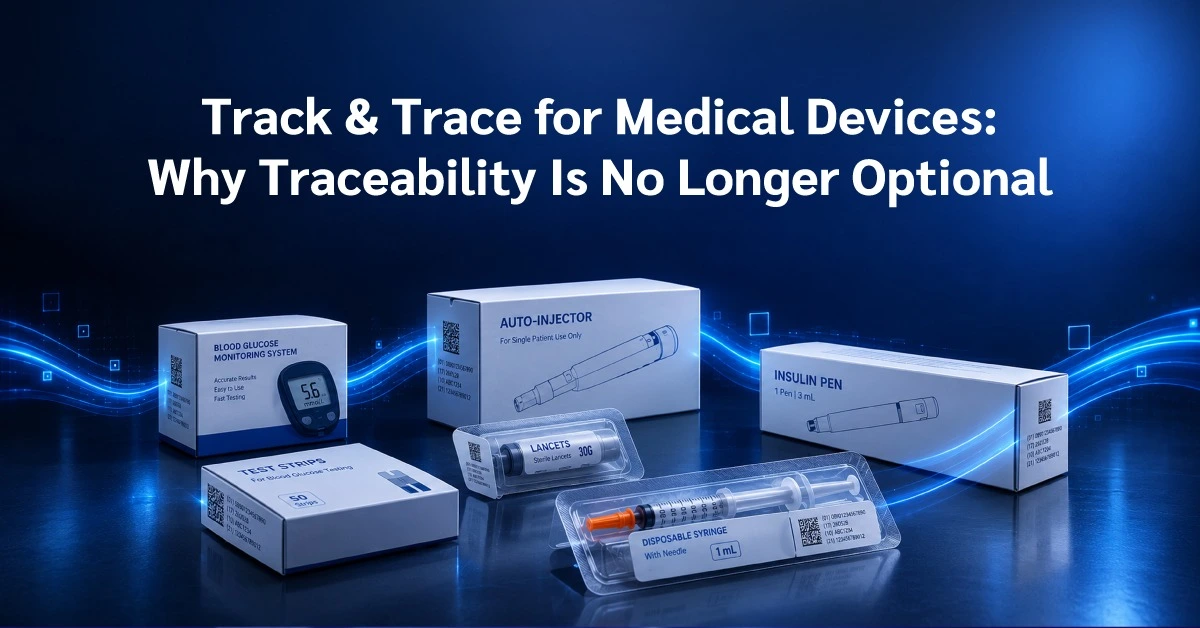
Track & Trace for Medical Devices: Why Traceability Is No Longer Optional
Medical devices travel a long road before they reach a patient, from raw material sourcing and manufacturing, through sterilization, packaging, distribution, and finally implantation or clinical use. At every one of these stages, something can go wrong: a mislabelled batch, a counterfeit component, a storage condition breach, or a device that needs to be recalled overnight. When that happens, the difference between a controlled, fast response and a chaotic, costly one comes down to one thing — traceability.
For manufacturers of medical devices, “Track And Trace” isn’t just a compliance checkbox anymore. It’s a core part of product quality, patient safety, and brand trust.
What Track & Trace Really Means for Medical Devices
At its core, track and trace is the ability to answer two simple questions at any point in a product’s life:
Where has this device been? (track — the forward journey from production to point of use)
Where did this device come from? (trace — the backward journey from any point back to raw materials and the exact production line, shift, and operator)
For medical devices, this typically means assigning a Unique Device Identification (UDI) to every unit or batch, capturing that identity at each critical process step, and linking it to data such as lot number, expiry date, sterilization cycle, inspection results, and shipping destination.
Why Traceability Matters So Much in Medical Devices
1. Patient Safety
If a device is later found to have a defect, manufacturers need to identify — within minutes, not days — exactly which units are affected, where they were shipped, and which patients or facilities received them.
2. Regulatory Compliance
Regulatory bodies worldwide now require formal traceability systems:
US FDA’s UDI rule (21 CFR Part 830)
EU MDR (2017/745) and its UDI/EUDAMED requirements
Similar frameworks emerging across other regulated markets
Non-compliance can mean product holds, fines, or loss of market access.
3. Counterfeit and Grey Market Prevention
Serialized, verifiable identifiers make it far harder for counterfeit or diverted devices to enter legitimate supply chains.
4. Efficient Recalls
A precise, digitized trace record can shrink a recall from an all-SKU, all-region operation to a narrowly targeted one — protecting both patients and the company’s reputation.
5. Manufacturing Quality & Yield Insights
Beyond compliance, traceability data is a goldmine for root-cause analysis, supplier quality tracking, and continuous improvement on the production line.
Where Machine Vision Fits In
Manual or barcode-only tracking systems struggle to keep pace with the speed, precision, and documentation demands of modern device manufacturing. This is where machine vision-based track and trace systems — like those built by Jekson Vision — add real value:
High-Speed Code Reading and Verification — 1D/2D barcodes, Data Matrix codes, and human-readable text are read and verified in real time on the line, at production speed.
Print Quality and Grading Checks — ensuring every code meets ISO/IEC grading standards before it leaves the facility.
Serialization and Aggregation — linking unit-level codes to case – and pallet-level codes for full parent-child traceability.
Vision-Based Inspection Integration — combining defect detection (labelling errors, missing components, seal integrity) with the same Vision System doing the code reading, so a single failure point catches both quality and traceability issues.
Seamless Data Integration — pushing captured data directly into MES, ERP, or track-and-trace software platforms for real-time visibility and audit-ready records.
Building a Traceability-Ready Line
For manufacturers evaluating or upgrading their track & trace infrastructure, a few principles matter most:
Start With the Standard — Design around UDI/DI-PI structures and regional regulatory formats from day one, not as an afterthought.
Inspect and Trace Together — Vision systems that combine quality inspection with code verification prevent bad units from ever entering the traceability chain.
Design for Line Speed — Traceability shouldn’t slow down production — vision-based systems should operate at full line throughput.
Plan for Aggregation, Not Just Serialization — Unit-case-pallet relationships matter as much as the individual code.
Make Data Usable, Not Just Captured — Integration with existing enterprise systems turns traceability from a record-keeping exercise into a real operational and safety tool.
Conclusion
Traceability in medical device manufacturing is no longer just about satisfying an auditor, it’s about protecting patients, protecting brands, and building manufacturing operations that can respond with speed and confidence when something goes wrong. With machine vision-driven track and trace systems, manufacturers can move from reactive compliance to proactive quality and safety management, one scanned code at a time.
Jekson Vision helps medical device manufacturers build robust, high-speed track and trace and inspection systems tailored to global regulatory requirements. To learn how a vision-based traceability solution could fit your production line, get in touch with our team.
Write to us at marketing@jeksonvision.com to know more.

Darshana Dhote
Marketing and Communication Strategist
RECENT POSTS