Meghna Dekhtawala / July 28, 2026 / Pharmaceuticals
10 Common Challenges in Pharmaceutical Packaging and How Vision Inspection Systems Solve Them
Why AI Vision Inspection Is Essential for Pharmaceutical Packaging
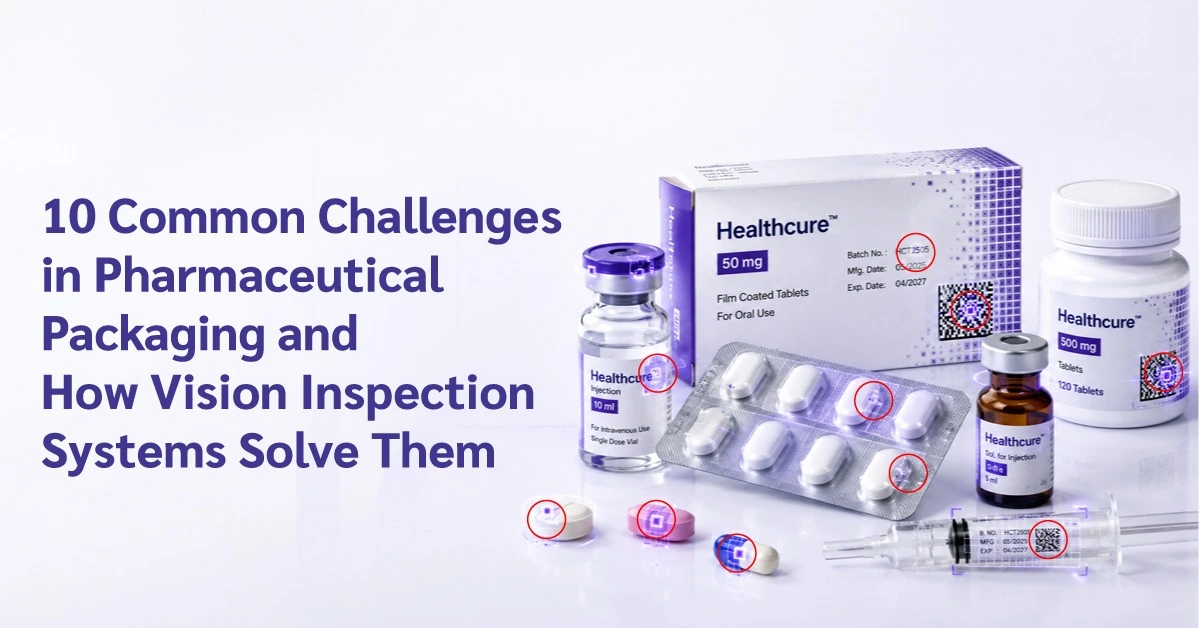
Pharmaceutical packaging lines run fast, change formats often, and carry zero tolerance for error. A single defective blister reaching the market can trigger a recall, a regulatory observation, and lasting brand damage. Yet most quality teams still rely on manual checks, sampling plans, or ageing rule-based cameras that were never designed for today’s product mix. Below are ten recurring pharmaceutical packaging challenges — and how a modern vision inspection system solves each one.
10 Pharmaceutical Packaging Challenges
1. Missing, Broken or Damaged Units in Blisters
Empty pockets, half tablets, chipped edges and cracked softgels escape human inspection at line speed. At 600–800 blisters per minute, no operator can reliably detect a hairline crack in a capsule shell. AI-driven blister inspection handles tablets, capsules, bilayer tablets, softgels and transparent capsules with multi color granules — including the notoriously difficult clear-shell products where conventional contrast-based systems fail. Every pocket is inspected, every batch, with image evidence retained.
2. Colour and Shape Mix-Ups
Colour mix, wrong orientation and foreign tablets are high-risk defects because they signal a line-clearance failure, not just a cosmetic one. Deep-learning models classify variants that rule-based algorithms confuse — two pink tablets differing only in emboss depth, or a bilayer tablet loaded upside down. This is genuine packaging quality control, not approximate sorting.
3. Transparent and Reflective Products
Transparent capsules, pre-filled syringes, vials and injectables reflect and refract light unpredictably. Standard lighting produces glare that masks defects and creates phantom ones. Purpose-built optics and lighting geometry make these products inspectable at full production speed, without slowing the line to compensate.
4. Tablet in Bottle Packaging Blind Spots
Tablets in bottles present count accuracy, cap presence/absence and seal integrity risks that blister lines don’t share.
5. Vial Cosmetic Defects
Cracked necks, chipped flanges, incorrect fill level and misapplied labels (Flagging, Cross labeling, Double Labelling, wrong alignment or missing label) are core vial rejects, and for sterile products they are patient-safety issues. Automated vision inspection grades cosmetic and dimensional defects consistently across every unit, not on a sample basis — removing the statistical gamble that sampling inherently accepts.
6. Label Placement and Content Errors
Skewed, torn, missing, wrinkled or wrong labels are among the most common recall triggers globally. A wrong-market label on a correct product is still a recall. A label inspection system validates presence, position, artwork version and print quality simultaneously, comparing against the approved master rather than a loose tolerance band.
7. Illegible Overprinting Data
Batch number, MFG, EXP, GTIN, 2D Data Matrix or any other code (1D, Pharmacode, Crypto Code, etc) and MRP printed on foil or carton must be machine-readable at the pharmacy, the distributor and the border. OCR/OCV verifies every character against the batch record, rejecting broken, smudged or shifted text before it becomes a distribution problem.
8. Variable Data and Serialisation Failures
Unique codes, GTIN and aggregation data demand barcode grading, not just decoding — a code that scans on your line may fail on a supermarket scanner. Print-and-inspect on cartons validates each code against ISO/GS1 grades before the pack advances, protecting DSCSA, EU FMD and MoH compliance and preventing costly rework of serialised stock.
9. False Rejects Destroying Yield
Over-sensitive systems reject good product, inflate material cost, and — worse — train operators to override alarms, which quietly defeats the entire inspection strategy. Inspection that avoids false rejects is where AI matters most: trained models separate acceptable cosmetic variation from genuine defects, cutting false reject rates sharply while maintaining zero-escape performance.
10. Manual Inspection Fatigue and Documentation Gaps
Human inspectors tire within twenty minutes of repetitive visual work, and audit trails go missing between shifts. Automated product inspection delivers 21 CFR Part 11-compliant records, batch reports, and defect images — evidence auditors accept immediately, without a scramble through paper logs.
The Business Case
Pharma manufacturers deploying AI vision inspection typically report fewer market complaints, higher OEE, faster changeovers and stronger audit outcomes. Recall avoidance alone usually justifies the investment; yield recovery from reduced false rejects funds it twice. The objective is simple: catch every defect, reject nothing good, and prove it.
Jekson Vision is among the few suppliers offering AI-integrated inspection across blister, bottle, vial, label, variable data and carton applications on a single platform — so quality standards stay consistent across every line in the plant.
Talk to our application team to review your line and defect library.
Calculate ROI for purchasing a Vision System, contact us on marketing@jeksonvision.com

Meghna Dekhtawala
Senior Marketing Manage
RECENT POSTS