



Build, upgrade or modernize your pharmaceutical serialization infrastructure with a scalable, GS1-based solution from Jekson Vision.
Jekson Vision provides integrated serialization, aggregation, vision inspection and enterprise traceability solutions for pharmaceutical manufacturers in Saudi Arabia, and for manufacturers, CMOs and CDMOs exporting medicines into the Kingdom.
Whether you are serializing a new packaging line, upgrading an existing system, adding case and pallet aggregation or preparing line-level data for the Saudi Food and Drug Authority (SFDA) Drug Track and Trace System, Jekson can help you design an architecture suited to your operation and to SFDA's requirements.
The Saudi Food and Drug Authority (SFDA) operates the Drug Track and Trace System (DTTS), also known in industry as RSD. It tracks pharmaceutical products from manufacturing or importation until patient use, across manufacturers, warehouses, pharmacies, and hospitals and other consumption centers. Every tracked drug unit carries a GS1-based DataMatrix, and every stakeholder in the system is identified by a Global Location Number (GLN). SFDA's Integration Guide states that marketing a drug unit is forbidden without registration in the system.
The coding requirements are set out in SFDA's Drug Barcoding Specifications (version 6.1), which urges both local manufacturers and international manufacturers exporting to Saudi Arabia to adopt GS1 supply-chain standards. Key milestones in the specification are:
GS1 DataMatrix with a unique serial number required on secondary packaging.
Aggregation barcoding required at case/outer-pack and pallet level, using SSCC.
The requirements currently apply to human drugs packaged and ready to be marketed. SFDA states that herbal and health products and veterinary pharmaceutical products will require barcoding in the future. Exempt products include free samples, non-registered drugs ordered by hospitals for specific patients in particular quantities, drugs cleared for personal use and drugs cleared for repackaging.
Jekson Vision does not administer Saudi Arabia's DTTS. Jekson provides the hardware, software, vision inspection and integration capabilities manufacturers use to generate, verify and manage serialized product data within that ecosystem.
The SFDA's Drug Barcoding Specifications set out the following:
| Requirement | What the Specification Says |
|---|---|
| Code | GS1 DataMatrix replaces the linear barcode. At minimum it encodes GTIN (AI 01), expiry date as YYMMDD (AI 17), batch/lot (AI 10, up to 20 alphanumeric characters) and serial number (AI 21, up to 20 alphanumeric characters), with FNC1 separators after the variable-length fields. |
| GTIN | GTIN-14 is the GTIN accepted by SFDA. Local companies obtain a GS1 Company Prefix and GLNs through GS1 Saudi Arabia. |
| Serial numbers | Determined by the pharmaceutical company itself with no third-party issuer, generated in a randomized manner and never reused for the same product. |
| Serialization level | Required on the secondary pack, which is the outer package of the product. Primary-pack coding is optional. |
| Aggregation | Mandatory according to GS1 standards. Cases/outer packs and pallets must carry an SSCC (AI 00) in a GS1-128 barcode or GS1 DataMatrix. GTIN + serial number may be used instead only for homogeneous cases and pallets, using the higher-level GTIN-14. Bundles and sub-cartons are optional. |
| Printed information | SFDA permits five options for what is encoded and what is shown in text. In four of the five, the expiry date must also appear on the outer pack in a clearer month-and-year format. The fifth encodes expiry as MMYYYY. |
| Printing and reading | Print the code on one side of the secondary pack, preferably a flat surface. Test that rubbing does not damage it and that it stays legible in moist conditions. It must be read with camera-based scanners, because laser scanners cannot read DataMatrix. |
| Internal systems | The manufacturer's system must store every serial number (SFDA's example is 10,000 boxes and 10,000 stored serials), handle aggregation according to GS1 standards, and extract aggregation files for product shipped to other stakeholders. |
Meeting SFDA's requirements is not simply about printing a code on a carton. The manufacturer's internal system must hold every serial number, manage aggregation to GS1 standards and produce aggregation data for product shipped to warehouses and other stakeholders. The packaging line, serialization software, aggregation process and enterprise traceability systems therefore need to work together, and the data they create must be accurate enough to be relied on by every party downstream.
A typical architecture: Product → Serialization → Vision Verification → Aggregation → Site Management → Enterprise Traceability → Supply Chain
Serialization printing, GS1 DataMatrix printing, barcode verification, OCR/OCV, reject management and commissioning.
Coordinate serialization across packaging lines, batches and production environments at your site.
REETRAK manages serial numbers, production data and packaging hierarchies at line and site level.
REESOURCE connects serialized product information across manufacturing, warehouse and distribution environments.
Connect traceability information across multiple sites, markets and systems, including external regulatory and partner systems where required.
One architecture. Multiple levels. Built to scale with SFDA requirements.
Serialization gives each saleable pack a unique identity. Aggregation records the parent-child relationship between those packs and the packaging levels they travel in, so a receiver can scan one code and know exactly what is in the shipment.
SFDA defines six packaging levels: primary pack, secondary pack, bundle, sub-carton or inner pack, case or outer pack, and pallet. Secondary-pack serialization is required, and case and pallet aggregation with SSCC is required. Primary-pack coding, bundles and sub-cartons are optional. Cases and pallets may be homogeneous (one product) or heterogeneous (mixed products). Heterogeneous units must use SSCC, and SSCCs must never be reallocated once assigned.
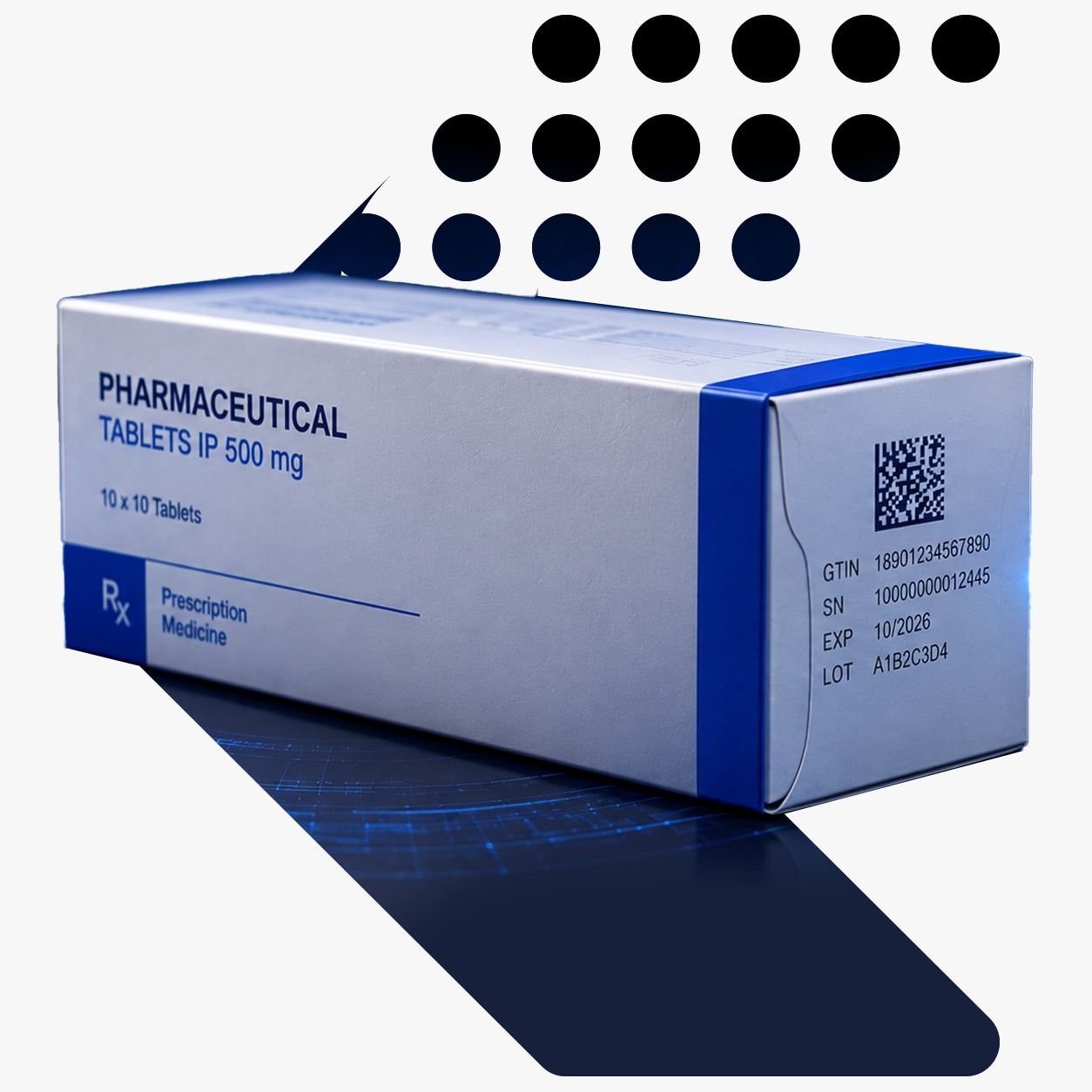
A code is only useful if every party can read it reliably, from the packaging line to the pharmacy. Because SFDA permits several printed-information options and requires camera-readable codes that survive rubbing and moisture, verification matters. Jekson's vision inspection systems verify the machine-readable and human-readable information printed on pharmaceutical packaging, with AI-enabled inspection available across the Jekson vision range.
Depending on the application, inspection can include GS1 DataMatrix verification, GTIN, serial number, batch number, expiry date, human-readable information compared with the encoded data, OCR/OCV, print quality grading, code readability, label verification, product presence, and SSCC and GS1-128 verification on cases and pallets.
Print → Inspect → Verify → Accept / Reject → Record
This helps prevent unreadable, incorrect or mismatched codes from leaving your facility.
Traceability in Saudi Arabia involves more than physical serialization. According to SFDA's Integration Guide, DTTS runs on SOAP-XML web services (SOAP 1.2). Every stakeholder needs a unique GLN and must obtain a username and password from SFDA. Operations are two-way: when one stakeholder dispatches product, the receiver must send an accept notification before anyone can act on it. Operations are based on GTIN and serial number, or on batch number.
The manufacturer is the first entry point of a product into DTTS. Locally made product is registered through the Supply operation and imported product through the Import operation, once all production or import phases are complete. The same GTIN and serial number cannot be added twice. DTTS also provides bulk file exchange (Package Transfer Service), which lets a manufacturer upload a file of GTIN, serial, batch and expiry data for product sent to a warehouse, and the warehouse download it. Before sending any notification to the production server, stakeholders must complete integration testing on SFDA's test server.
A serialization architecture should therefore cover both physical product identification and electronic traceability data. Depending on the project, this can involve:
REETRAK provides line and site-level serialization and aggregation within Jekson's traceability ecosystem, built on GS1 standards, managing serial numbers, product and batch data, packaging hierarchy, exceptions, rework, audit trails, user access and reporting.
REESOURCE provides the enterprise layer, designed to connect serialized product information across manufacturing, warehouse, distribution and enterprise environments, and to prepare it for regulatory and partner reporting.
Can REESOURCE integrate with ERP, MES and WMS systems? Yes. REESOURCE is designed to integrate with existing enterprise systems and packaging-line infrastructure, depending on the project architecture.
Product entering Saudi Arabia must be registered in DTTS through the Import operation before it is marketed, and every unit needs a GS1 DataMatrix with a unique serial number plus SSCC-coded cases and pallets. The serialization and aggregation data originates at your packaging site. Foreign manufacturers and CMOs therefore need to give their Saudi importer or warehouse clean, complete serialized and aggregated data, in the right format, before shipment.
Jekson can help you structure line-level data so your Saudi partner can register it accurately, while keeping the same architecture for your other markets. Confirm with your importer which party submits the DTTS notifications.
Many manufacturers supplying Saudi Arabia already serialize for the EU, the USA, Egypt or India. The gap is often in market-specific encoding, case and pallet aggregation, reporting formats or aging equipment rather than in the whole system. Jekson can conduct a line study and recommend the right approach: retrofit, replacement, an additional line, or integration with suitable existing equipment. Whether a line can be retrofitted depends on its equipment, configuration and project requirements.
It is far more efficient to design serialization and traceability into a new line than to add them later. Jekson can design serialization and traceability into cartoning, blister, bottle, vial and labeling lines, case packing, aggregation stations and warehouse operations: Serialization → Vision Inspection → Aggregation → Site-Level Management → Enterprise Traceability.