Meghna Dekhtawala / August 22, 2026 / Packaging Line
Kenya Pharmaceutical Serialization: Is Your Packaging Line Ready for the New Track & Trace Era?
Kenya’s pharmaceutical supply chain has entered a new phase of digital traceability. The country’s National Track and Trace System is part of a broader government effort to improve supply-chain visibility, strengthen medicine authentication and address the risks posed by substandard and falsified medical products.
For pharmaceutical manufacturers, importers, distributors and other stakeholders, the change is more than a regulatory technology project. It has direct implications for the packaging line.
The key question is no longer whether pharmaceutical traceability is becoming part of Kenya’s medicine supply chain. The more practical question is: Is the packaging line ready to generate, print, verify and manage serialized pharmaceutical products?
What Is Kenya’s Pharmaceutical Serialization Requirement?
Pharmaceutical Serialization gives an individual saleable pack a unique identity. Instead of identifying only a product and batch, serialization makes it possible to distinguish one pack from another through a unique serial number associated with the product’s digital record.
Kenya’s National Track and Trace System is being implemented as part of the country’s pharmaceutical digital transformation. The Ministry of Health announced that the National Track and Trace System would become operational on 1 July 2026, with the objective of improving transparency, supply-chain visibility and patient safety. The Ministry has also stated that digital track-and-trace systems will use serialization and other technologies to support medicine authenticity from production to the point of care.
A regulatory implementation notice reported in July 2026 sets out a phased transition, with batch-level traceability during the transition period and full compliance, including unit-level serialization aligned with GS1 standards, from 1 January 2027. Because implementation guidance can evolve, manufacturers should verify the latest requirements directly with the Pharmacy and Poisons Board (PPB) before finalising a compliance project.
For the Pharmaceutical Industry, this creates a clear preparation window. Serialization should be treated as a packaging-line readiness exercise, not simply as the purchase of a printer.
Why Is Kenya Moving Toward Pharmaceutical Track & Trace?
The objective of pharmaceutical Track & Trace is straightforward: improve visibility of medicines as they move through the legitimate supply chain.
Counterfeit, falsified and substandard medicines can enter complex distribution networks at different points. A stronger digital identity for pharmaceutical products can help regulators and supply-chain participants establish where a product originated, identify its batch and, where unit-level serialization is used, distinguish an individual pack.
Kenya’s Ministry of Health has linked the country’s digital track-and-trace reforms to efforts to combat counterfeit medicines and improve medicine safety. The National Track and Trace System is intended to strengthen visibility across the pharmaceutical Supply Chain.
This is where serialization becomes important. A barcode alone does not create traceability. The barcode must be connected to reliable product data, and the physical pack must remain correctly linked to its digital identity throughout the process.
What Does Pharmaceutical Serialization Mean for a Kenyan Carton?
For manufacturers preparing for unit-level serialization, the saleable pharmaceutical carton becomes an important point of control.
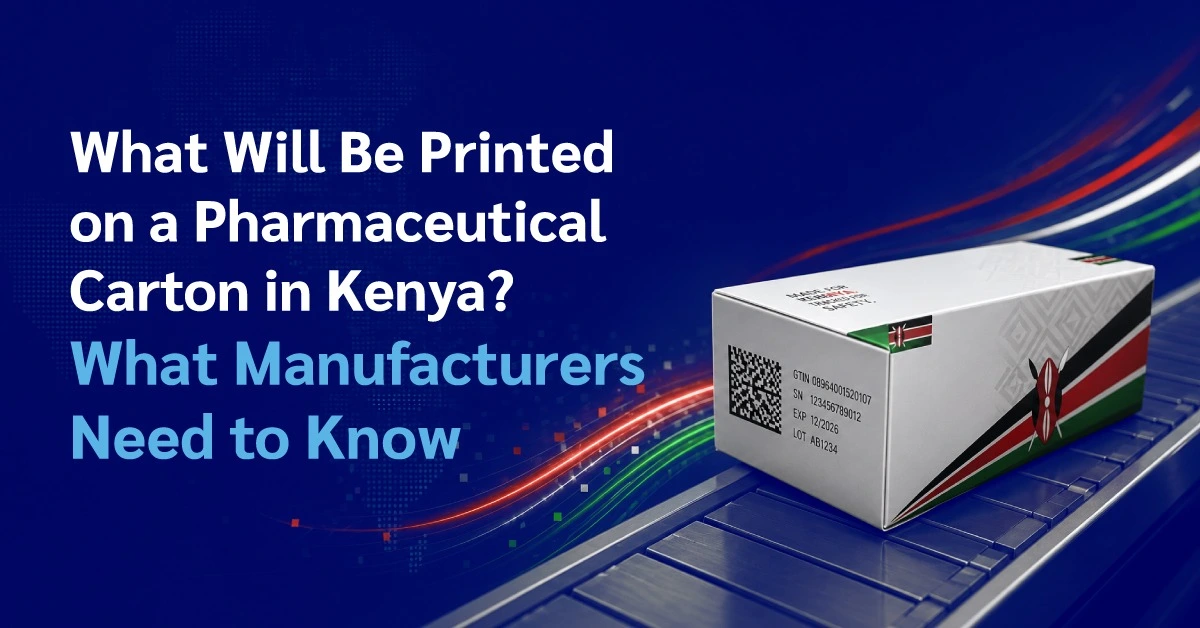
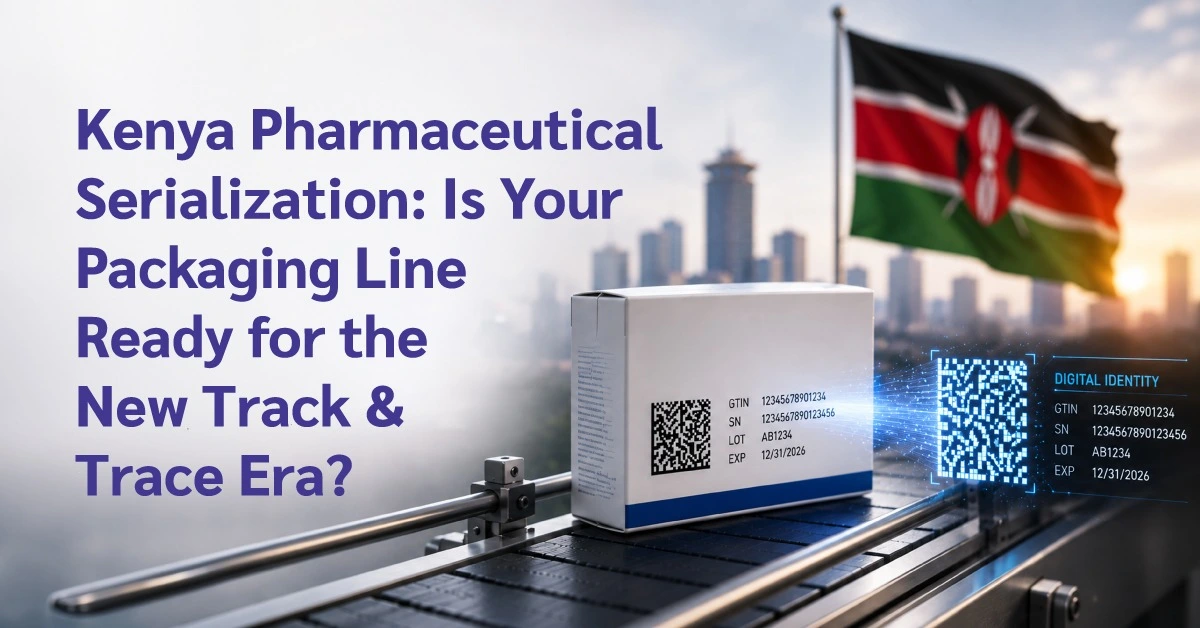
A GS1 Data Matrix can carry several pieces of product information within a compact 2D symbol. GS1 guidance identifies the Data Matrix as a key 2D carrier for healthcare applications and explains that it can encode information such as the GTIN, batch or lot number, expiry date and serial number. GS1 Kenya similarly highlights the use of Data Matrix for healthcare traceability and high-speed capture of variable product data.
What Information Is Included in a Serialized Pharmaceutical Carton?
- GTIN – Global Trade Item Number, identifying the product
- Serial Number, providing a unique identity to the individual pack
- Batch/Lot Number, identifying the manufacturing batch
- Expiry Date, identifying the product’s expiry information
- Human-readable information, where required by the applicable product and regulatory requirements
The exact data elements, application identifiers, placement and implementation requirements should be confirmed against the latest PPB and GS1 guidance applicable to the product and market.
For a packaging-line manager, however, the important point is clear: the information printed on the carton must be accurate, readable and associated with the correct serialized record.
Why Pharmaceutical Serialization Is More Than Printing a Data Matrix
One of the easiest mistakes in a serialization project is to think of serialization as a printing problem.
It is not.
A serialization-ready packaging line needs to manage a sequence of connected activities:
Generate → Print → Inspect → Verify → Reject → Record → Report
The serial number has to be generated or received from the appropriate serialization system. The correct data then needs to reach the printer. The printer must apply the code consistently at production speed. A vision system or code reader must confirm that the code is present and readable and, where required, verify that the encoded information corresponds to the expected product data.
If a pack contains an incorrect, duplicate, missing or unreadable code, the line must be able to identify and reject it.
The result is a fundamental shift in how packaging lines need to be considered. Serialization connects packaging equipment, machine vision, automation, software and data management into one process.
How to Assess Your Existing Packaging Line for Serialization Readiness
For many pharmaceutical manufacturers in Kenya, the first question may be whether serialization requires an entirely new packaging line.
In many cases, it does not.
The more useful starting point is a serialization readiness assessment of the existing line.
A manufacturer should examine:
1. Printing capability
Can the existing coding system print a high-quality 2D Data Matrix at the required production speed? Is there enough space on the carton for the code and required human-readable information?
2. Vision inspection
Can the line automatically detect whether the code is present and readable? Can it identify print defects that could result in an unsuccessful scan?
3. Data verification
Can the system compare the printed information with the expected serialization data rather than simply checking whether a black-and-white square is present?
4. Reject capability
Can the line reliably remove a failed pack without affecting good product or creating uncertainty about which serial numbers were actually rejected?
5. Software integration
Can the packaging line communicate with the serialization software and the higher-level systems needed for data management and regulatory reporting?
6. Production speed
Can serialization and inspection operate at the line’s actual production speed without becoming a bottleneck?
7. Validation and compliance
Can the complete solution be validated and operated with appropriate controls, audit trails and user permissions where required?
These questions help manufacturers determine whether an existing line needs a targeted upgrade, a new serialization station or a more extensive packaging-line modification.
What Is Aggregation and How Does It Differ From Serialization?
Serialization and aggregation are often discussed together, but they solve different problems.
Serialization identifies the individual unit. Aggregation establishes relationships between packaging levels.
For example, aggregation can link multiple serialized cartons to a bundle, multiple bundles to a case, and cases to a pallet. Scanning the parent package can then provide information about the serialized units associated with it.
For manufacturers planning a Kenya pharmaceutical serialization project, aggregation should therefore be evaluated separately from unit-level serialization. The applicable Kenyan implementation requirements should determine what is mandatory, while manufacturers can also consider whether an aggregation-ready architecture would support future export markets or operational requirements.
This distinction can prevent unnecessary capital expenditure while still allowing the packaging infrastructure to evolve.
Why GS1 Standards Matter
A national Track and Trace system needs a common language for identifying products and exchanging information.
GS1 standards provide that common framework. GS1 Kenya describes its standards as a way to identify, capture and share supply-chain data consistently. In healthcare, GS1 Data Matrix supports the encoding of product identifiers and variable information in a compact format suitable for pharmaceutical applications.
For pharmaceutical manufacturers, this means serialization should not be approached as an isolated machine-level exercise. Product identification, barcode structure, serial number management, data exchange and verification all need to work together.
What Should Manufacturers Do Before the 2027 Milestone?
The period before full unit-level serialization compliance should be used for preparation rather than last-minute installation.
A practical readiness program can begin with five steps.
Step 1: Map the current packaging process
Identify where product identification, printing, inspection, rejection and data capture currently take place.
Step 2: Identify the gaps
Determine whether existing printers, cameras, controllers, software and network infrastructure can support serialization.
Step 3: Define the serialization architecture
Establish how serial numbers will be generated, how they will reach the packaging line, how codes will be verified and how packaging events will be recorded.
Step 4: Test at production speed
A code that works perfectly during a demonstration is not necessarily a code that will remain reliable at production speed. Testing should reflect the actual carton, substrate, printer, line speed, lighting and environmental conditions.
Step 5: Plan for future requirements
The most cost-effective solution is not necessarily the one with the fewest features. It is the one that meets current requirements while allowing future capabilities to be added without replacing the complete packaging architecture.
How Does Vision Inspection Support Pharmaceutical Serialization?
The relationship between serialization and vision inspection deserves particular attention.
A serialized code is only useful if it can be read reliably. Pharmaceutical manufacturers therefore need to consider not only whether a code has been printed, but whether its quality is sufficient for successful machine reading.
Vision inspection can help identify problems such as incomplete printing, distortion, poor contrast, damaged symbols or incorrect placement. It can also support the verification of the information encoded in the Data Matrix against the expected data.
This is where serialization and pharmaceutical vision inspection come together: the printer creates the identity; the inspection system helps prove that the physical pack carries the correct identity.
A Compliance Requirement Can Become a Packaging-Line Upgrade Opportunity
Kenya’s pharmaceutical serialization journey is fundamentally about improving traceability and supply-chain integrity. But for manufacturers, it also creates an opportunity to modernise packaging operations.
A well-designed serialization solution can bring together printing, vision inspection, rejection, software integration and data management instead of treating each as a separate upgrade.
For manufacturers already operating established packaging lines, this can mean upgrading the parts that need to change while retaining equipment that continues to perform effectively.
That approach can reduce disruption, protect existing investments and create a more scalable packaging platform.
What Should a Manufacturer Look for in a Kenya Serialization Solution?
Before selecting a pharmaceutical serialization solution, manufacturers should look beyond the printer specification.
The right solution should be evaluated on:
- Serialization capability – Can it manage unique product identities reliably?
- GS1 compatibility – Can it support the required identification and barcode standards?
- Code verification – Can it inspect and verify the printed Data Matrix?
- Packaging-Line Integration – Can it communicate with existing packaging equipment and controls?
- High-speed operation – Can it work without reducing required production performance?
- Reject management – Can failed packs be removed reliably?
- Data integrity – Can physical products remain accurately linked to digital records?
- Scalability – Can additional Track & Trace requirements be incorporated later?
- Validation and compliance support – Can the system support the documentation and controls expected in a regulated pharmaceutical environment?
These considerations are particularly important when the objective is not simply to meet one deadline, but to establish a packaging platform that can adapt as Kenya’s pharmaceutical traceability ecosystem develops.
Kenya Pharmaceutical Serialization: The Time to Prepare Is Now
Kenya’s National Track and Trace System marks an important development in the country’s pharmaceutical supply chain. The implementation of digital traceability, together with the move toward GS1-aligned serialization, is changing the way pharmaceutical manufacturers need to think about product identification and packaging.
For manufacturers, the biggest risk is not necessarily the Data Matrix itself. The bigger risk is discovering too late that the existing packaging line cannot reliably generate, print, verify, reject and manage serialized products at production speed.
A serialization project therefore needs to begin with the line, the data and the future regulatory roadmap — not just the printer.
The manufacturers that assess their packaging infrastructure early will have more time to identify gaps, compare upgrade options, validate equipment and implement changes without unnecessary pressure on production.
Kenya’s pharmaceutical Track & Trace era is moving from policy to implementation. The question is no longer whether serialization will affect the packaging line. The question is whether the packaging line is ready for it.
Jekson Vision provides pharmaceutical serialization, vision inspection and Track & Trace solutions designed to help manufacturers integrate product identification, code verification and packaging-line automation into a scalable pharmaceutical production environment.
Frequently Asked Questions About Pharmaceutical Serialization in Kenya
What is pharmaceutical serialization in Kenya?
Pharmaceutical serialization assigns a unique identity to an individual saleable medicine pack, allowing it to be distinguished from other packs of the same product and supporting digital traceability through the pharmaceutical supply chain.
What is the Kenya National Track and Trace System?
It is a national digital system intended to improve visibility and traceability of pharmaceutical products through the Kenyan supply chain. Kenya’s Ministry of Health announced its operational rollout in July 2026.
What is a GS1 Data Matrix?
A GS1 Data Matrix is a compact 2D barcode capable of carrying product identification and variable information such as GTIN, batch or lot number, expiry date and serial number. It is widely used in healthcare traceability applications.
Does serialization require a new packaging line?
Not necessarily. Existing packaging lines can often be assessed for upgrade opportunities involving printers, vision inspection, rejection systems, controls and serialization software. The appropriate approach depends on the line configuration, speed, product formats and applicable regulatory requirements.
Is aggregation the same as serialization?
No. Serialization gives an individual unit a unique identity. Aggregation links individual serialized units to higher packaging levels such as cases and pallets. The two capabilities should be evaluated separately when planning a Track & Trace project.
Why is vision inspection important for pharmaceutical serialization?
Vision inspection can help verify that the serialized code is present, readable and correctly printed, and can support comparison of printed information with expected product data. This helps prevent incorrectly coded packs from continuing through the packaging process.

Meghna Dekhtawala
Senior Marketing Manage
RECENT POSTS