Ritesh Indulkar / April 15, 2026 / Pharmaceuticals
Reducing False Rejection Rates in Automated Quality Inspection
- False rejection risk: Good products may be rejected when a vision system cannot separate acceptable variation from actual defects.
- Business impact: High false rejection increases wastage, rework, operator frustration, and hidden production costs.
- Root causes: Rigid programming, poor image capture, unrealistic tolerances, and weak changeover handling can all increase false rejects.
- System quality: Reliable inspection depends on balanced logic, stable image acquisition, intelligent algorithms, and realistic validation.
- Practical goal: The right vision system should detect real defects, avoid unnecessary rejection, and keep production running efficiently.
In any production setup where inspection systems are installed, the expectation is simple: detect defects and allow good products to pass.
But in reality, many manufacturers face a different problem—products that are perfectly acceptable are being rejected.
This is known as false rejection, and it quietly eats into margins.
At first, it may look like a small issue.
A few extra rejects here and there.
But over time, it adds up to serious wastage, unnecessary rework, and frustration on the shop floor.
The real problem is not inspection itself.
The problem is choosing a system that cannot differentiate properly between acceptable variation and actual defects.
What is False Rejection?
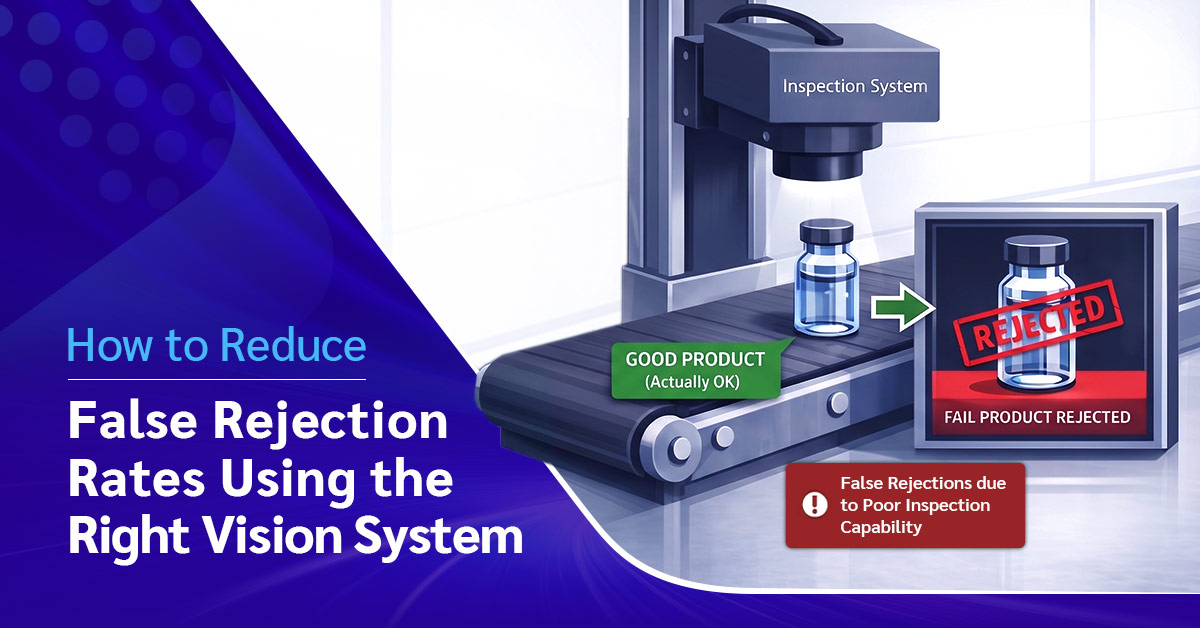
False rejection happens when a vision system flags a good product as defective.
The product meets quality standards, but the system rejects it anyway.
This is different from missing a defect.
In false rejection, the system is too sensitive or not intelligent enough to understand real-world variations.
Why False Rejection Becomes a Serious Problem
Many companies tolerate false rejection in the beginning, assuming it is part of automation.
But it is not something that should be accepted.
1. Direct Material Loss
Every rejected product means:
- Wasted material
- Wasted printing
- Wasted processing time
If rejection rates are even slightly high, the financial impact becomes significant.
2. Increased Rework
Rejected products often need to be:
- Rechecked
- Reprocessed
- Repacked
This adds extra load on operations and reduces efficiency.
3. Loss of Confidence in the System
Operators quickly notice when good products are being rejected. Over time, they start:
- Ignoring system outputs
- Manually overriding decisions
- Double-checking everything
This defeats the purpose of automation.
4. Production Slowdowns
Frequent false rejects create interruptions.
Teams spend more time handling rejected products than focusing on smooth production.
Why Many Vision Systems Struggle
There are many inspection systems available in the market at different price points.
On paper, they all claim to perform inspections.
But in practice, their performance varies widely.
The main issue is how the system makes decisions.
1. Rigid Programming
Basic systems work on fixed rules:
- Compare image to the reference
- If the difference exceeds a limit → reject
This approach does not handle natural variation well.
2. Lack of Understanding of Real Products
No two products are exactly identical.
There will always be small variations in:
- Printing
- Material
- Alignment
A system that expects perfect uniformity will reject too many products.
3. Poor Image Capture Conditions
If the system is not designed properly:
- Lighting may be uneven
- Images may not be consistent
This leads to unstable inspection results.
4. Improper Setup
Even a good system can perform badly if:
- Calibration is incorrect
- Reference images are not selected properly
- Tolerances are not set realistically
5. Frequent Product Changes
In many industries, multiple SKUs run on the same line.
If the system does not manage changeovers properly, it starts rejecting products unnecessarily.
The Cost of Choosing the Wrong System
One of the most common mistakes is selecting a system based on initial price.
A lower-cost system may look attractive at the beginning, but if it leads to higher false rejection, the long-term cost becomes much higher.
Let’s consider a simple example:
- Production: 50,000 units per day
- False rejection: 1.5%
- Product cost: ₹40
That means:
- 750 good products are rejected daily
- Daily loss: ₹30,000
- Monthly loss: ₹9,00,000
This does not include rework costs or production inefficiencies.
What Makes a Vision System Reliable?
Reducing false rejection is not about reducing sensitivity.
It is about improving decision quality.
A good vision system should be able to:
- Understand acceptable variation
- Identify real defects accurately
- Remain stable across different conditions
1. Balanced Inspection Logic
The system should not be overly strict or overly lenient. It should be tuned to:
- Reject actual defects
- Accept valid variations
This balance is critical.
2. Proper Image Acquisition
The foundation of any inspection system is image quality. This depends on:
- Correct lighting design
- Stable mounting
- Suitable camera resolution
If the input is poor, the output will also be unreliable.
3. Intelligent Algorithms
Instead of simple pixel comparison, better systems use:
- Pattern recognition
- Context-based analysis
This allows them to make more accurate decisions.
4. Well-Defined Tolerances
Tolerance settings should reflect real production conditions. If tolerances are too tight:
- False rejection increases
If too loose:
- Defects may pass
Finding the right balance is key.
5. Proper Training and Validation
Before going live, the system should be tested with:
- Good samples
- Defective samples
- Borderline cases
This helps in setting realistic inspection parameters.
Practical Steps to Reduce False Rejection
Step 1: Review Current Rejection Data
Start by analyzing:
- How many products are rejected? Your rejection has to be way less than 1%
- How many of those are actually good
This gives a clear picture of the problem.
Step 2: Check System Setup
Look at:
- Lighting conditions
- Camera positioning
- Stability of the setup
Small improvements here can make a big difference.
Step 3: Adjust Tolerances Carefully
Avoid setting very tight limits just to be safe.
Instead:
- Define acceptable variation
- Tune the system accordingly
Step 4: Improve Reference Standards
The reference image or template should represent real production, not an ideal sample.
Using a perfect sample often leads to unnecessary rejection.
Step 5: Handle Product Variations Properly
If multiple variants are running:
- Ensure correct program selection
- Use separate profiles if needed
Step 6: Work with the Right Supplier
This is often overlooked.
A good supplier will:
- Understand your application
- Customize the solution
Support optimization after installation
Role of Advanced Vision Systems
More advanced systems are designed to handle variability better.
They can:
- Adapt to changes in conditions
- Reduce dependency on rigid thresholds, Jekson’s latest systems do AI-based thresholding & tolerance
This results in:
- Lower false rejection
- More stable performance
Long-Term Benefits of Reducing False Rejection
When false rejection is under control, the impact is visible across operations.
- Reduced Wastage
Fewer good products are discarded.
- Better Efficiency
Less time spent handling rejected items.
- Improved Operator Trust
Teams rely on the system instead of questioning it.
- Higher Return on Investment
The system delivers real value instead of creating hidden costs.
False rejection is often treated as a minor technical issue, but it is actually a business concern.
It affects:
- Cost
- Productivity
- System reliability
The solution is not just installing a vision system, but selecting one that is suited to your application and setting it up correctly.
At Jekson Vision, the focus is on delivering inspection systems that work in real production conditions—where variation exists, and decisions need to be practical.
The goal is simple:
Detect real defects, avoid unnecessary rejection, and keep production running efficiently.
Schedule a call with us to know more, write to us at marketing@jeksonvision.com

Ritesh Indulkar