



Tea is one of the most residue-scrutinised food commodities entering the EU and Japan. Border rejections are public, searchable (EU RASFF portal, Japan MHLW violation lists), and permanently visible to every buyer who researches you. A single lot-level failure without the ability to isolate the affected batch can convert a residue exceedance into a full-consignment — or full-supplier — rejection.
The consequence: importers have pushed compliance risk upstream. Their audits of exporters now go beyond certificates and ask a harder question: “If this lot fails at the border, can you prove — with data — exactly which garden, which processing date, which packing line, and which shipment it maps to?” Paper registers no longer pass that test with tier-1 buyers.
“Tea falls under the EU Deforestation Regulation (EUDR).” It does not. EUDR covers cattle, cocoa, coffee, palm oil, rubber, soy and wood. Tea is out of scope. However, several EU buyers are voluntarily extending EUDR-style plot-level traceability expectations to tea in their supplier codes — so you may be asked for garden geolocation data anyway, contractually rather than legally. Know the difference; it changes how you negotiate.

The EU General Food Law (Regulation EC 178/2002) requires every food business operator in the chain to identify their immediate supplier and immediate customer for every lot. Your EU importer is legally on the hook for this — which is why their supplier audits demand that you maintain lot-level records linking incoming leaf, blends, processing batches, and outgoing shipments. If your batch coding is illegible, missing, or duplicated across cartons, their traceability chain legally breaks at you.
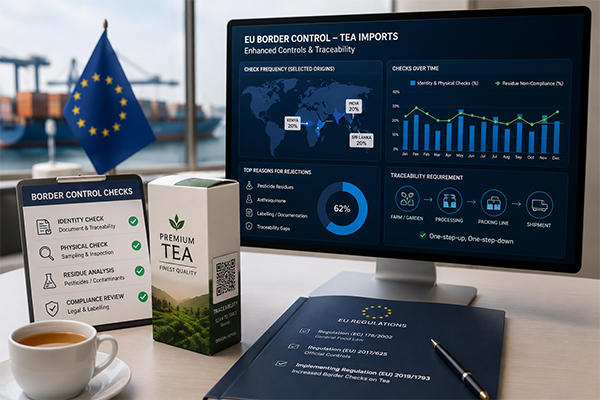
Under Regulation (EU) 2017/625 and Implementing Regulation (EU) 2019/1793, tea from certain origins is on the EU's list of foods subject to a temporarily increased frequency of identity and physical checks at the border — driven historically by pesticide residues (and anthraquinone findings) on tea. The listed origins and check percentages are revised roughly every six months, so verify the current annex before each season. Practical implications:
Swipe the table sideways to see all columns.
| Audit point | What they look for | Common failure |
|---|---|---|
| Batch/lot code printing | Legible, correct, permanent codes on primary pack, carton and pallet; codes match ERP/records | Smudged or missing inkjet codes; no verification that the code was actually printed correctly |
| Label & artwork control | Correct language, correct MRL - relevant claims, correct best-before logic per market | Wrong-market artwork packed after changeover; manual checking only |
| Mass balance | Incoming leaf per lot ≈ output packed per lot, with reconciliations | Blend records that can't isolate a garden |
| Mock recall | Trace a finished lot back to gardens and forward to shipments in under 4 hours (many buyers now demand under 2) | Paper registers taking days; codes not machine-readable |
| Coding verification | Evidence that every printed code was inspected — not sampled manually | No camera/vision verification; operator sign-off only |
Japan is often a tougher residue market than the EU, but a lighter documentary one. Key differences your team must plan for:
Food Sanitation Act: Any pesticide without an established MRL for tea defaults to a uniform limit of 0.01 ppm. Compounds that pass EU limits can fail Japan. Your lot-level segregation must therefore work by destination market, not just by grade.
Monitoring Orders: A single violation can move your product/origin combination to 100% inspection (“inspection order”) for extended periods — a commercial death sentence for delivery reliability. Lot isolation is your only containment tool.
Japanese-language labels with lot identification; importers audit whether your printing and inspection process can guarantee the correct Japanese artwork and legible lot codes at line speed.
Japanese buyers audit process discipline — they will ask how a wrong or unreadable code is physically prevented from leaving the plant, not just how it is detected in records.
What is it: Sunrise 2027 is a GS1-led global industry initiative (not a law) targeting that by the end of 2027, retail point-of-sale systems worldwide can scan 2D barcodes — GS1 DataMatrix and QR codes carrying GS1 Digital Link — alongside traditional EAN/UPC codes. During the transition, GS1 recommends dual marking: keep the EAN/UPC and add a 2D code.
Nothing switches off on 1 January 2027. EAN/UPC will keep scanning after 2027. But exporters who wait for a mandate will retrofit printing, vision inspection and data systems under buyer deadline pressure — at panic prices. Those who dual-mark early turn it into a selling point in buyer audits now.
Russia's compliance regime is different in character from the EU and Japan — it is less about residue documentation and far more about a mandatory national digital track-and-trace system that every unit must carry before it can legally circulate.
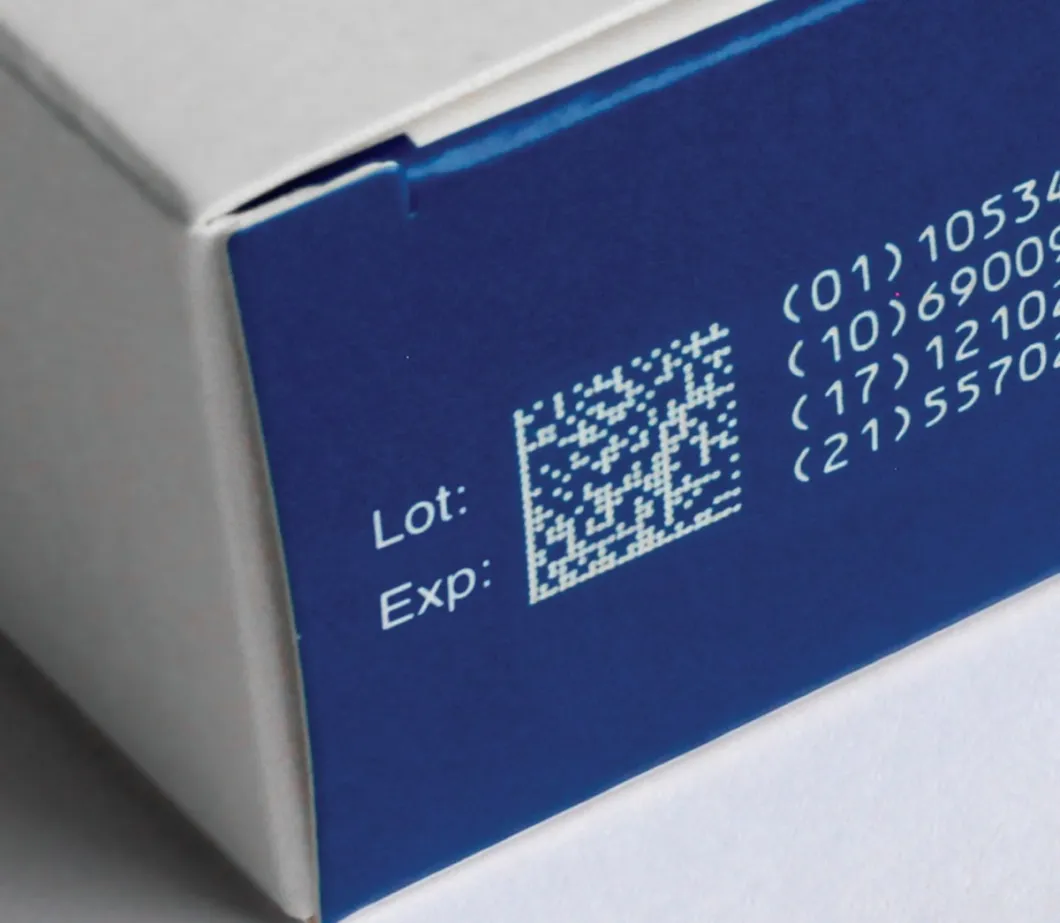
Chestny ZNAK is Russia's national marking and traceability system under Federal Law No. 487-FZ, operated by CRPT. Scope is expanding steadily category by category — coffee (beans, ground, instant, capsules) is already a mandatory category, and food/beveragefood/beverage categories continue to be added by government decree, most recently dietary supplements from March 2026. Exporters should treat tea as a strong candidate for the next expansion wave rather than assume permanent exemption — check current CRPT category lists (or your importer) each season, not once.
Where it applies, the requirements are specific and non-negotiable:
Chestny ZNAK penalties apply across the whole chain — production, import, storage, transport, sale — and legal entities face the steepest fines (reported up to roughly RUB 300,000–500,000 per violation category), plus confiscation and market exclusion. Unlike an EU border rejection, a Chestny ZNAK failure can halt goods already inside Russian distribution, not just at the border.
Practically: Russia asks for the same underlying capability as the EU and Japan — verified, unit-level, auditable codes tied to real batch data — but delivered through a specific mandatory government system rather than a buyer's private audit. A packing line built to print and verify variable 2D data for Sunrise 2027 (Section 4) is largely the same infrastructure Chestny ZNAK requires; the gap is usually the registration/reporting integration with the CRPT system, not the print and inspection hardware itself.
Score yourself honestly. Buyers' auditors will.
Every incoming leaf lot has a unique ID linked to garden/estate and date of receipt.
Blend sheets record exact lot proportions — a finished lot can be decomposed into source gardens.
One-up/one-down records exist for every shipment and are retrievable in minutes, not days.
Mock recall completed in the last 12 months, documented, finished in under 4 hours end-to-end.
Lot segregation by destination market (EU-cleared vs Japan-cleared residue profiles).
Analytical reports (MRL panels) are mapped to specific lot codes, not to “the season”.
Batch/lot code, best-before, and market-specific data printed online (not pre-printed generic).
100% automated verification that each code printed is present, legible, and correct — camera-based, not sampling.
Wrong-artwork / wrong-market pack detection at changeovers (label and carton inspection).
Reject mechanism physically removes failed packs — non-conforming product cannot proceed.
Print quality of any 2D code is graded (ISO/IEC 15415) so it will scan at retail POS and border checkpoints.
GS1 company prefix and GTIN structure in place; 2D code content (GTIN + batch + expiry) defined with buyers.
Packing lines can print variable 2D codes at rated line speed without slowing throughput.
Vision system validates 2D code data content against the batch record — not just readability.
Aggregation capability (pack → carton → pallet) if buyers require case-level scanning.
All inspection results logged with audit trail, exportable for buyer audits and border queries.
Russia-bound lines: DataMatrix printing/verification and CRPT registration workflow fully scoped.
Find answers to common questions about our solutions.