Darshana Dhote / January 27, 2026 / Inspection Series
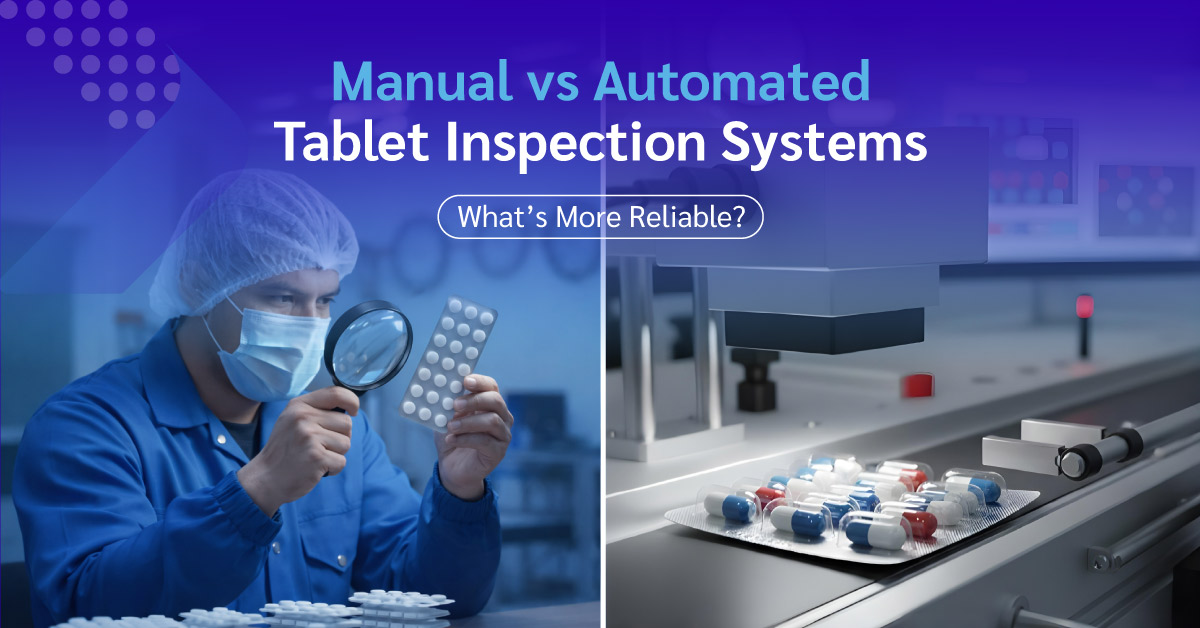
Manual vs Automated Tablet Inspection Systems: What’s More Reliable?
TL;DR
- The Challenge: Manual tablet inspection is limited by human fatigue, inconsistent accuracy, slow speed, and difficulty detecting micro-level defects—especially problematic at high production volumes.
- Automated Advantage: AI-powered tablet inspection systems use high-resolution cameras and machine learning to detect macro and micro defects with over 99% accuracy at high speeds.
- Operational Impact: Automated systems deliver a 35-40% reduction in batch rejection rates, cut manual labor costs by half, and typically achieve ROI within 18-24 months.
- AI Capabilities: Modern systems feature auto-teaching, adaptability to product variations, reduced false rejections, predictive defect analysis, and multi-recipe handling for scalable production.
- Compliance & Market Growth: Automated inspection ensures CFR 21 Part 11 compliance with digital traceability and audit-ready documentation, driving the pharmaceutical inspection market from $1.2B in 2024 to a projected $2.5B by 2033.
Every tablet that leaves a pharmaceutical production line carries the responsibility of safety, accuracy, and compliance.
Yet defects such as chipping, cracks, colour variation, or contamination can easily go unnoticed—especially at high production speeds.
While manual inspection has long been used to identify these issues, increasing complexity and scale are exposing its limitations.
Traditionally, tablet inspection relied on manual visual checks.
Today, rising production speeds, stricter regulations, and higher quality expectations are driving the shift toward AI-powered automated inspection—raising the question of which approach is truly more reliable.
Why Tablet Inspection Is Critical in Pharma Manufacturing
Tablets are high-volume solid dosage forms, often produced at thousands of units per minute.
At this scale, even a small percentage of defects can translate into significant quality risks.
Tablet inspection ensures:
- Correct tablet shape, size, and colour.
- Absence of cracks, chips, or broken edges.
- Clean tablet surfaces free from foreign particles.
- No mixed or wrong tablets.
- Consistent quality across batches.
An inspection system must therefore be accurate, repeatable, and capable of operating reliably at high speed.
Manual Tablet Inspection Systems
Manual tablet inspection depends entirely on human visual judgment.
How Manual Tablet Inspection Works
- Tablets are presented on trays or slow-moving conveyors.
- Operators visually examine tablets under fixed lighting.
Defects identified include:
- Broken or chipped tablets
- Cracks or fractures
- Colour or coating inconsistencies
- Black spots, specks, or contamination
- Incorrect or mixed tablets
Defective tablets are manually removed.
Challenges of Manual Tablet Inspection
While manual inspection may appear simple, it has significant limitations:
- Inspection accuracy varies between operators
- Human fatigue reduces detection capability over time
- Subtle or micro-level defects are often missed
- Inspection speed is limited
- Results are subjective and difficult to validate
- Manual documentation makes compliance and audits challenging
As tablet production volumes increase, maintaining consistent inspection quality through manual methods becomes increasingly difficult.
Automated Tablet Inspection Systems
Automated tablet inspection systems use high-resolution cameras, controlled illumination, and AI-based vision software to inspect every tablet consistently and objectively.
How Automated Tablet Inspection Works
- Tablets move through a conveyor-based inspection system.
- Multiple high-resolution cameras capture images of each tablet.
Advanced vision algorithms analyze:
- Tablet shape and dimensional accuracy
- Edge chipping and cracks
- Colour and coating uniformity
- Surface defects and contamination
- Tablet mix-ups or incorrect products
Defective tablets are automatically rejected in real time without stopping production.
AI-Powered Tablet Inspection: A Smarter Approach
Modern systems, such as AI-powered tablet inspection platforms, use deep learning (DL) and machine learning (ML) to improve inspection reliability.
Key Capabilities of AI-Based Tablet Inspection:
- Auto-teaching: One-time teaching without complex parameter setting
- Adaptability: Handles variations in tablet shape, colour, and texture
- High-speed inspection: Suitable for continuous, high-throughput production
- Reduced false rejections: Smarter defect classification
- Predictive defect analysis: Learns and improves over time
- Multi-recipe handling: Supports multiple tablet formats
- CFR 21 Part 11 compliance: Ensures regulatory readiness
- Digital traceability: Automated data logging for audits
These systems remove subjectivity and deliver consistent inspection results across shifts, batches, and production lines.
Manual vs Automated Tablet Inspection: Key Comparison
| Parameter | Manual Tablet Inspection | Automated Tablet Inspection |
|---|---|---|
| Inspection Accuracy | Operator-dependent | High and repeatable |
| Defect Detection | Limited to visible defects | Detects macro & micro defects |
| Speed Capability | Low to moderate | High-speed compatible |
| Consistency | Variable | Uniform across batches |
| Human Fatigue Impact | High | None |
| Adaptability | Manual re-training required | AI-driven adaptability |
| Data & Traceability | Manual records | Digital logs & reports |
| Regulatory Compliance | Difficult to validate | CFR-compliant systems |
| Scalability | Limited | Highly scalable |
Conclusion
In the comparison of manual vs automated tablet inspection systems, automation is the more reliable, efficient, and future-ready solution.
Automated inspection systems powered by AI and machine vision deliver:
- Superior defect detection
- Consistent inspection quality
- Higher throughput
- Reduced operational dependency
- Audit-ready digital traceability
As pharmaceutical manufacturers continue to scale production while maintaining strict quality standards, automated tablet inspection systems are no longer an option—they are a necessity.
To know more about automated Tablet Inspection Systems, write to us at marketing@jeksonvision.com